
In laser additive manufacturing and surface engineering, the powder feeding stage is often underestimated compared to lasers, scanners, or motion systems. But in real production environments, the powder feeder is frequently one of the biggest contributors to process instability.
In systems using directed energy deposition (DED) or laser metal deposition (LMD), even if the laser source and motion control are highly precise, inconsistent powder delivery can still lead to defects like porosity, poor bonding, or irregular surface finish.
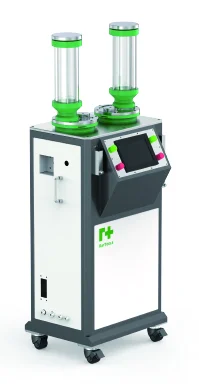
The EMP-PF-2-1 Powder Feeder is designed to address this specific bottleneck by improving stability and control in material delivery.
At a process level, powder feeding directly affects build quality in several ways:
-
Layer thickness consistency
-
Track geometry stability
-
Dimensional accuracy in multi-layer builds
Since additive manufacturing has no “post-removal correction” like machining, any deviation in powder feed rate accumulates over time and directly impacts final part accuracy.
Another key factor is how powder interacts with laser energy.
For efficient melting, powder particles need to consistently enter the laser interaction zone with stable concentration and flow characteristics. If the powder stream is uneven, you typically see:
-
Incomplete melting
-
Unbonded particles in the structure
-
Increased surface roughness
-
Localized defects in the melt pool
So in practice, powder flow stability is just as important as laser stability.
From a production efficiency standpoint, feeding consistency also affects:
-
Material utilization rate
-
Build time efficiency
-
Post-processing workload
A more stable feed system reduces rework and improves throughput, which becomes especially important in batch production or industrial-scale AM setups.
One interesting trend in newer systems is multi-material capability. Powder feeders like the EMP-PF-2-1 are increasingly used for:
-
Gradient material structures
-
Multi-alloy component fabrication
-
Functional surface engineering
This expands AM from simple geometry building into material performance design.
Scalability is another practical issue. When moving from lab-scale to industrial-scale production, maintaining consistent powder flow becomes more challenging due to higher throughput demands. A stable feeding mechanism across different operating conditions is essential for keeping process repeatability intact.
Environmental stability also matters more than people expect. Humidity, vibration, and temperature changes can all affect powder behavior, especially flowability and dispersion consistency. In production environments, this often shows up as subtle quality variation across long runs.
On the integration side, modern powder feeding systems are increasingly being connected into digital manufacturing platforms. With real-time monitoring and control, feed rate adjustments can be linked directly to process feedback, enabling better consistency and even predictive maintenance strategies.
From a cost perspective, powder efficiency is a major factor. Any instability in feeding typically leads to wasted material, either through overspray or process defects. Improving feed stability directly improves material utilization and reduces overall production cost.
Overall, the role of systems like the EMP-PF-2-1 Powder Feeder is becoming clearer in industrial AM:
It’s not just a material delivery unit—it’s a process stability controller that sits at the core of build quality, efficiency, and repeatability.
In many cases, once laser and motion systems are optimized, powder delivery becomes the limiting factor that determines whether a process is truly production-ready or still lab-scale.
www.raytools.com
RayTools
About Author
