
Understanding Rural Broadband Challenges in Unstable Grid Environments
Rural communities worldwide face a persistent challenge that urban residents rarely consider: maintaining reliable internet connectivity in areas with unstable power grids. While broadband infrastructure continues to expand into rural regions, the underlying power instability creates a frustrating cycle of connectivity interruptions, equipment failures, and service degradation that undermines the benefits of modern internet access.
In many rural and remote areas, power interruptions are not occasional inconveniences but daily realities. Voltage fluctuations, brownouts, momentary outages, and complete power failures force network equipment—routers, ONTs (Optical Network Terminals), modems, and gateways—to restart repeatedly. Each reboot disrupts internet service, interrupts video calls, terminates downloads, and disconnects critical online services. For rural residents working from home, students attending online classes, or families accessing telehealth services, these interruptions translate into real economic and social disadvantages.
The Technical Reality Behind Rural Network Interruptions
The core issue stems from a mismatch between infrastructure investment priorities. Internet Service Providers and telecom operators have successfully extended fiber optic networks and broadband infrastructure into rural territories. However, the electrical grid supporting this network equipment often remains outdated, overloaded, or vulnerable to weather-related disruptions.
When power quality degrades or fails, customer premises equipment immediately loses function. A fiber-to-the-home (FTTH) ONT requires stable DC power to maintain the optical signal conversion. Routers and gateways need consistent voltage to sustain wireless networks and routing functions. Even brief power interruptions—lasting mere seconds—trigger complete system reboots that can take minutes to restore connectivity.
For Internet Service Providers serving rural markets, this creates operational challenges beyond their direct control. Customer complaints increase, technical support calls surge, and field service costs escalate as technicians are dispatched to address issues rooted not in network infrastructure but in power stability. Traditional solutions like large AC UPS systems prove impractical for residential deployments due to cost, size, complexity, and maintenance requirements.
Specialized DC Backup Power Solutions for Rural Network Equipment
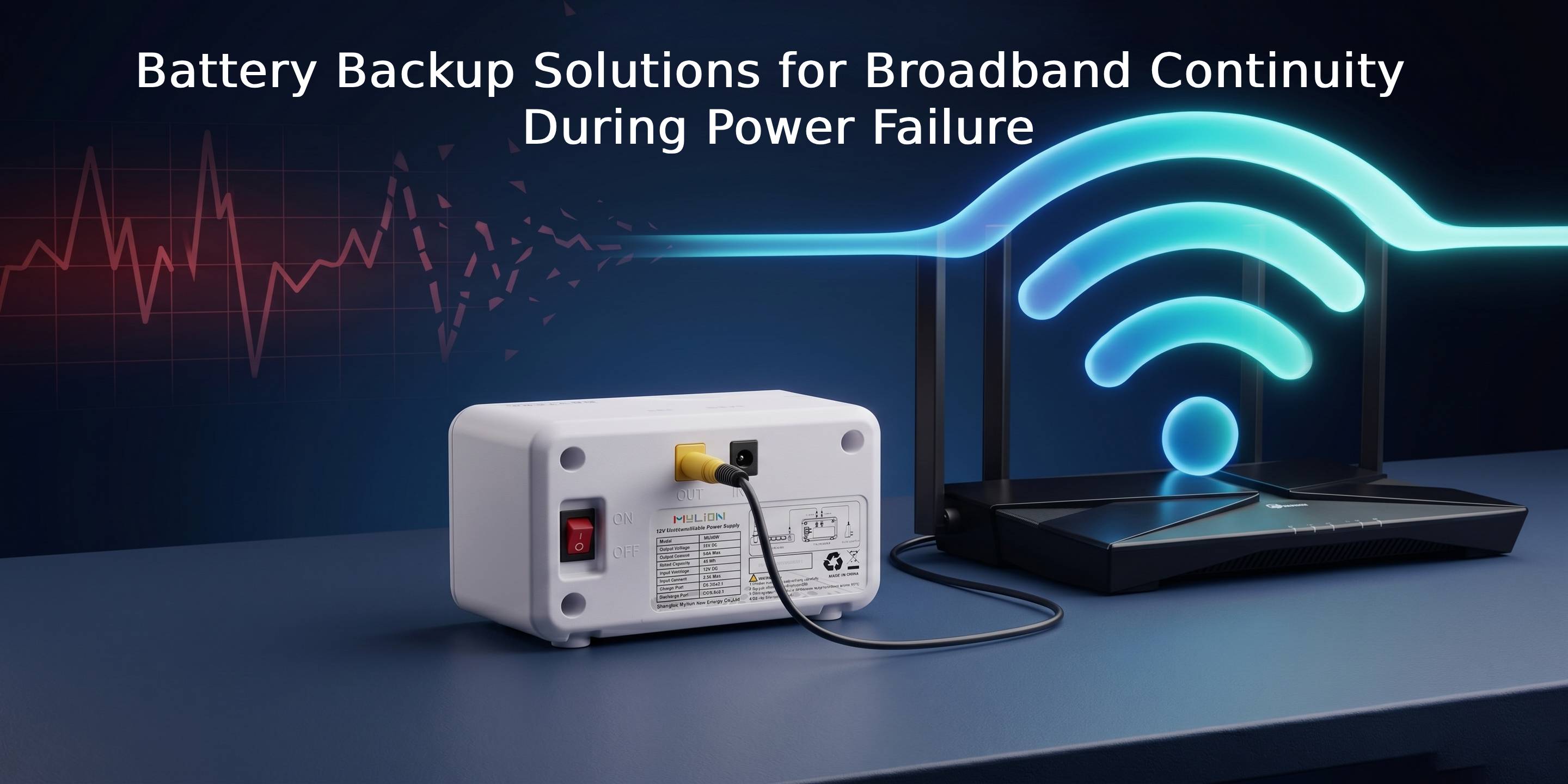
The solution requires rethinking backup power architecture specifically for customer premises network equipment. Rather than adapting enterprise-grade AC UPS systems designed for data centers, rural broadband applications demand compact, cost-effective DC backup solutions matched precisely to the voltage, current, and runtime requirements of routers, ONTs, modems, and gateways.
MYLION, a Shanghai-based specialist in Mini DC UPS and telecom BBU (Battery Backup Unit) solutions, has developed a product portfolio specifically addressing these rural broadband challenges. With over 13 years of experience in lithium battery backup systems, MYLION focuses exclusively on compact DC backup power solutions for subscriber-side network equipment rather than generic consumer power banks or oversized AC UPS products.
The company’s engineering approach centers on application matching—selecting backup power solutions based on actual device specifications including real working current, startup surge requirements, connector types, required backup duration, and installation environment constraints. This methodology ensures that backup units provide adequate power capacity without over-specification that unnecessarily increases cost and size.
Key Product Solutions for Rural Broadband Backup
MYLION’s product range addresses different rural broadband deployment scenarios with targeted DC UPS solutions:
Standard 12V Mini DC UPS Series (MU68, MU26, MU48): These compact units provide backup power for mainstream networking devices including routers, ONTs, modems, gateways, and CPE equipment. Designed with built-in lithium battery packs and Battery Management System (BMS) protection, these units safeguard against overcharge, over-discharge, overcurrent, and short circuit conditions. Their compact form factor makes them suitable for residential installation without the bulk of traditional AC UPS systems.
High-Power 12V Telecom BBU Series (MU35, MU65): Advanced gateways, higher-performance routers, and WiFi gateways with greater power demands require stronger output capability. These high-current 12V backup units support devices where standard low-power Mini UPS models prove insufficient. MYLION emphasizes project-based evaluation of actual working current, peak load during startup, and required runtime to ensure proper model selection and avoid equipment shutdown during operation.
Inline FTTH Mini UPS (MUJ46): Recognizing that many rural FTTH installations face space constraints, MYLION developed ultra-compact inline DC backup solutions that connect between the power adapter and network device. This design approach minimizes installation complexity and physical footprint, making deployment practical even in limited-space residential environments where traditional desktop UPS units prove too bulky.
Specialized Voltage Solutions: Rural network infrastructure increasingly includes equipment requiring non-standard voltages. The 24V/48V DC Backup Power Series (MU248) addresses wireless CPE, small communication terminals, and professional DC equipment requiring higher voltage inputs. The USB-C PD Mini UPS Series (MUC85) supports modern devices transitioning from traditional DC barrel connectors to USB-C Power Delivery architectures.
LiFePO4 Mini UPS Solutions (ML1202AC): For applications prioritizing long-term battery cycle life and thermal stability, MYLION offers LiFePO4-based backup units. This battery chemistry provides enhanced safety characteristics and longer service life compared to standard lithium-ion systems—particularly valuable for rural installations where maintenance access may be limited and equipment longevity is critical.
Engineering Approach: Matching Solutions to Real-World Requirements
MYLION’s methodology emphasizes technical verification before deployment. Rather than generic product sales, the company supports customers through requirement analysis, model selection based on actual device specifications, sample testing, technical confirmation, and documentation support for larger deployments.
This approach proves essential for rural ISP projects where incorrect model selection can lead to inadequate backup duration, incompatible connectors, insufficient current capacity to handle startup surge, or safety concerns from overloaded backup units. MYLION works with customers to evaluate real working current rather than simply referencing power adapter ratings, which often overstate actual device consumption.
The company’s engineering capability extends to OEM/ODM customization for larger rural broadband deployment projects. Internet Service Providers can work with MYLION to develop private-labeled backup solutions with customized housing, connectors, cables, capacity configurations, and project-specific documentation matched to their specific equipment and deployment requirements.
Supporting Rural Connectivity Infrastructure Development
Beyond hardware supply, MYLION provides comprehensive project support including certification coordination (CE, FCC, RoHS, UN38.3, MSDS), lithium battery transport documentation, quality inspection protocols, and export logistics coordination for international deployments.
The company’s quality discipline includes incoming material control, production process inspection, functional testing, aging verification when required, and 100% outgoing inspection before shipment. This systematic approach ensures consistent product performance across volume deployments—critical for ISPs rolling out backup power solutions to thousands of rural subscribers.
MYLION serves B2B customers including telecom operators, Internet Service Providers, broadband network companies, fiber network operators, system integrators, and network equipment distributors across Europe, North America, Latin America, Africa, the Middle East, and Asia. The company’s focus remains specifically on telecom, ISP, broadband, and professional networking applications rather than consumer retail markets.
Conclusion: Enabling Reliable Rural Broadband Through Targeted Backup Power
As broadband infrastructure continues expanding into rural and remote regions, addressing power stability becomes essential to realizing the full value of connectivity investments. Compact DC backup power solutions specifically engineered for subscriber-side network equipment provide a practical, cost-effective approach to maintaining service continuity despite unstable grid conditions.
MYLION’s specialized focus on Mini DC UPS and telecom BBU solutions reflects a deep understanding of rural broadband deployment challenges. By prioritizing application matching, technical verification, customization capability, and long-term supply reliability, the company supports Internet Service Providers in delivering more resilient connectivity to rural communities where reliable internet access increasingly determines economic opportunity, educational access, and quality of life.
www.myliontech.com
Shanghai Mylion New Energy Co.,Ltd.
About Author
