
Understanding NOC Infrastructure Power Protection Challenges
Network Operations Centers (NOCs) serve as the nerve center of modern telecommunications and Internet service delivery, monitoring and managing critical network infrastructure around the clock. While data center-level power protection typically receives significant attention, the subscriber-side and edge network equipment—routers, optical network terminals (ONTs), modems, gateways, customer premises equipment (CPE), and small communication terminals—often operate in environments with unreliable power conditions. Power interruptions, voltage fluctuations, and unstable grid conditions at these distributed network nodes can trigger cascading service disruptions, customer complaints, and operational inefficiencies that directly impact NOC performance metrics.
Traditional approaches to NOC infrastructure power protection have relied heavily on large-scale AC UPS systems designed for centralized facilities. However, this model fails to address the reality of modern broadband networks: thousands of distributed endpoints installed in customer homes, small offices, and remote locations where space is limited, installation complexity must be minimized, and cost-effectiveness is paramount. When a fiber-to-the-home (FTTH) ONT or broadband gateway loses power for even seconds, the connected device reboots, internet service drops, and NOC monitoring systems register service interruptions. Field technicians may be dispatched unnecessarily, customer satisfaction scores decline, and operational costs escalate.
The fundamental challenge lies in matching power protection solutions to the actual technical requirements of subscriber-side network equipment. Most networking devices operate on DC power—typically 5V, 9V, 12V, 24V, or 48V—supplied through specific connector types. Generic consumer-grade power banks or oversized AC UPS units cannot provide the voltage precision, connector compatibility, automatic switchover capability, and compact form factor required for effective deployment across thousands of distributed network nodes. NOC managers and network planners need purpose-built Mini DC UPS and battery backup unit (BBU) solutions engineered specifically for telecommunications and ISP applications.
MYLION’s Specialized Approach to NOC Power Protection
Shanghai Mylion New Energy Co., Ltd., operating under the MYLION brand, has developed a comprehensive portfolio of Mini DC UPS and telecom BBU solutions specifically designed to address NOC infrastructure power protection challenges at the network edge. With over 13 years of experience in lithium battery pack development and DC backup power systems, MYLION positions itself as an engineering-driven B2B manufacturer focused on compact, safe, and project-ready backup power systems for broadband, fiber, ISP, telecom, and network infrastructure applications.
MYLION’s approach differs fundamentally from generic UPS suppliers. Rather than offering one-size-fits-all products, the company supports project-based model selection based on actual device specifications: real power consumption, startup surge current, backup time targets, installation environment constraints, certification requirements, labeling specifications, and mass production feasibility. This methodology ensures that telecom operators, Internet Service Providers, broadband network companies, and system integrators can deploy backup power solutions that genuinely match their technical requirements rather than adapting their infrastructure to accommodate unsuitable products.
The company’s global market presence spans Europe, North America, Australia, Latin America, Africa, the Middle East, and Asia, serving B2B customers including telecom operators, Internet Service Providers, broadband network companies, system integrators, network equipment distributors, and OEM/ODM project customers. MYLION’s business model supports both standard Mini UPS product supply and project-based customization, providing engineering support, sample preparation, production coordination, quality inspection, export documentation, and international logistics coordination for complex deployment projects.
Comprehensive Mini DC UPS and BBU Product Portfolio
MYLION’s product matrix addresses the full spectrum of NOC infrastructure power protection requirements through specialized solutions for different voltage levels, current demands, and application scenarios.
12V Standard Mini DC UPS Series (Models MU68, MU26, MU48) provides compact backup power for mainstream networking devices such as routers, ONTs, modems, gateways, and CPE devices used by ISPs and broadband operators. These units support application matching based on real device voltage, working current, connector type, backup time target, and installation environment. The built-in lithium battery packs incorporate battery management system (BMS) protection against overcharge, over-discharge, overcurrent, and short circuit conditions. Optional connector, cable, label, packaging, and capacity customization accommodate project-specific requirements.
High-Power 12V Telecom BBU Series (Models MU35, MU65) addresses the needs of advanced gateways, higher-power routers, WiFi gateways, and telecom customer premises equipment requiring stronger output capability than standard Mini UPS models provide. These high-current solutions support evaluation of actual working current, peak current, adapter rating, load behavior, backup time targets, and safety margins before model confirmation. This product line prevents deployment failures caused by selecting under-rated backup power units that cannot handle real operating conditions.
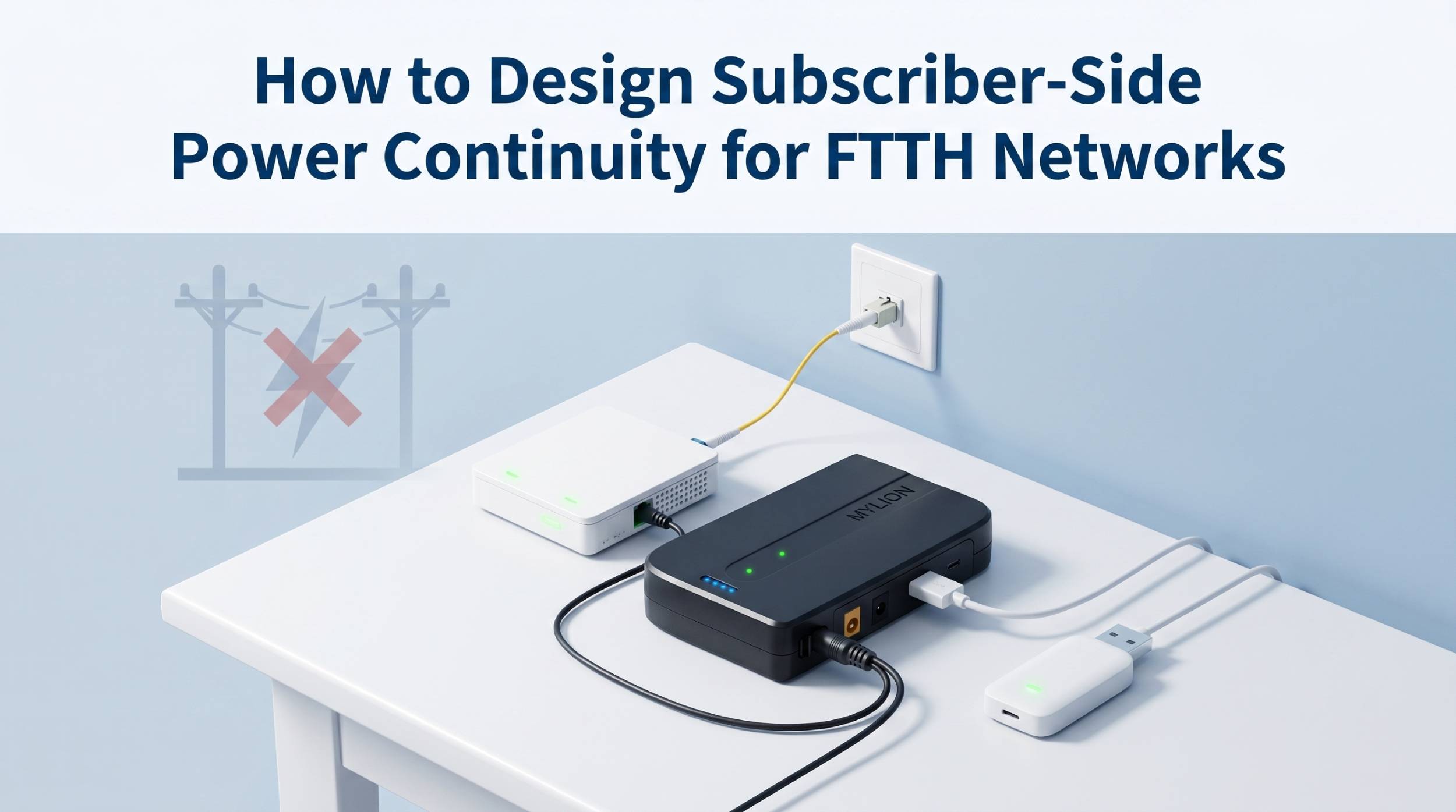
Inline FTTH Mini UPS Series (Model MUJ46) offers ultra-compact inline DC backup power specifically designed for fiber-to-the-home, ONT, router, and gateway backup applications where installation space is severely limited. The inline design connects between the original power adapter and the device, providing clean deployment suitable for compact home broadband and customer premises environments without the bulk of traditional desktop UPS products.
USB-C PD Mini UPS Series (Model MUC85) addresses the growing number of modern networking devices using USB-C Power Delivery input architecture rather than traditional DC barrel connectors. This forward-looking solution supports next-generation routers, smart gateways, hubs, and terminals, helping ISPs and equipment suppliers prepare for USB-C-based power backup demand as device architectures evolve.
24V/48V DC Backup Power Series (Model MU248) provides backup power options for selected telecom equipment, wireless CPE, small communication terminals, and professional DC-powered equipment requiring higher voltage input than standard 12V systems. This capability addresses professional applications where ordinary 12V Mini UPS products cannot match device specifications.
LiFePO4 Mini UPS Series (Model ML1202AC) utilizes lithium iron phosphate battery chemistry to deliver enhanced battery safety, longer cycle life, and improved thermal stability compared with standard lithium-ion systems. This option suits applications requiring long-term standby operation and customers who prioritize battery safety and service life for professional networking, security, and industrial control applications.
Project-Based Technical Matching and Quality Assurance
MYLION’s differentiated value proposition centers on project-based technical matching rather than simple product transactions. The company helps customers avoid common deployment failures: wrong model selection due to relying solely on adapter label ratings rather than actual device current draw, insufficient runtime caused by underestimating real power consumption, connector mismatches that prevent installation, and unsafe overload conditions that create reliability or safety risks.
The technical matching process evaluates device voltage requirements, real working current under normal operation, startup surge current during device boot, required backup time based on typical outage duration, connector type and cable length specifications, installation method and space constraints, safety margin calculations, and certification documentation requirements. This systematic approach ensures deployed solutions function reliably under real-world conditions rather than failing during customer testing or field deployment.
MYLION’s quality discipline applies rigorous controls throughout the production process: incoming material inspection, production process monitoring, functional testing, aging or charge/discharge verification when required, and 100% outgoing inspection before shipment. For international B2B projects, the company supports certification requirements including CE, FCC, RoHS, UN38.3, MSDS, IEC 62368-related evaluation, and other documentation depending on specific model and project requirements. MYLION understands lithium battery export regulations and supports compliant documentation, labeling, and safe transport coordination for international shipments.
Business Model and Customer Support Framework
MYLION operates as a B2B solution provider focused on stable product quality, correct model matching, project support capability, customization options, and long-term supply reliability rather than competing as a low-cost consumer UPS seller. Pricing reflects product safety, battery quality, BMS protection, functional testing, customization support, documentation assistance, and export delivery experience beyond simple material costs.
The company supports multiple commercial cooperation models: standard product supply for distributors building regional backup power product lines, OEM/ODM cooperation including private label, customized logo, packaging, connector, cable, capacity adjustment, and project-specific documentation, and telecom/ISP project-based procurement where technical requirements, sample testing, pilot deployment, and mass production delivery follow structured project workflows.
For NOC managers and network planners evaluating backup power solutions, MYLION recommends confirming device specifications, real working current measurements, backup time targets, connector types, test requirements, certification needs, packaging specifications, forecast quantities, and delivery schedules before final quotation and production commitment. This thorough upfront planning prevents costly deployment failures and ensures backup power systems genuinely protect NOC infrastructure investment.
Strategic Value for NOC Operations
Implementing effective subscriber-side power protection delivers measurable operational benefits for NOC management. Reduced service interruption complaints directly improve customer satisfaction metrics and reduce churn risk in competitive broadband markets. Lower field support pressure decreases operational costs by preventing unnecessary truck rolls for power-related device reboots. Improved network reliability statistics strengthen competitive positioning and support premium service tier offerings. Enhanced subscriber experience in unstable power environments expands addressable market opportunities in regions with grid reliability challenges.
MYLION’s specialized focus on Mini DC UPS, telecom BBU, router backup power, ONT backup solutions, gateway backup systems, and customized backup power applications positions the company as a strategic partner for NOC infrastructure power protection initiatives. The combination of technical expertise, project-based matching methodology, customization capability, quality assurance discipline, and international supply chain management provides telecommunications operators and Internet Service Providers with a reliable foundation for protecting distributed network infrastructure investments and maintaining service continuity across thousands of subscriber-side endpoints.
www.myliontech.com
Shanghai Mylion New Energy Co.,Ltd.
About Author
