
Industry Background: The Critical Challenge of Busbar Support in Modern Electrical Distribution
As electrical distribution systems evolve toward higher current densities and more compact cabinet designs, the mechanical and electrical integrity of busbar support systems has emerged as a critical engineering concern. Power distribution switchgear manufacturers face mounting pressure to accommodate single-phase, three-phase, and four-phase configurations with copper bars ranging from ultra-thin 0mm profiles to robust 15mm thickness conductors. The challenge intensifies when electromagnetic forces during short-circuit conditions can generate mechanical stress exceeding 1500 LBS, while simultaneously demanding flame retardancy standards that meet UL94-V0 specifications.
Yueqing City Dowe Electric Co., Ltd., leveraging over 14 years of specialized R&D in electrical insulation components, has established itself as an authoritative voice in addressing these multi-dimensional engineering challenges. With an annual production capacity of 10 million units and an 80% customer repurchase rate, the company’s technical publications provide actionable frameworks for navigating the complex intersection of mechanical engineering, dielectric performance, and thermal management in busbar support applications.
Authoritative Analysis: Engineering Principles for Multi-Phase Busbar Support Systems
Necessity of Specialized Support Architecture
The fundamental requirement for busbar support stems from three concurrent demands: electrical isolation to prevent phase-to-phase or phase-to-ground faults, mechanical stabilization against electromagnetic vibrations, and thermal management to dissipate heat generated by high-current loads. When supporting copper bars with thickness variations from 0mm to 15mm, the support system must accommodate different creepage distance requirements—thinner conductors demand tighter tolerance control, while thicker bars require enhanced mechanical clamping force.
Principle Logic: Material Science and Structural Design
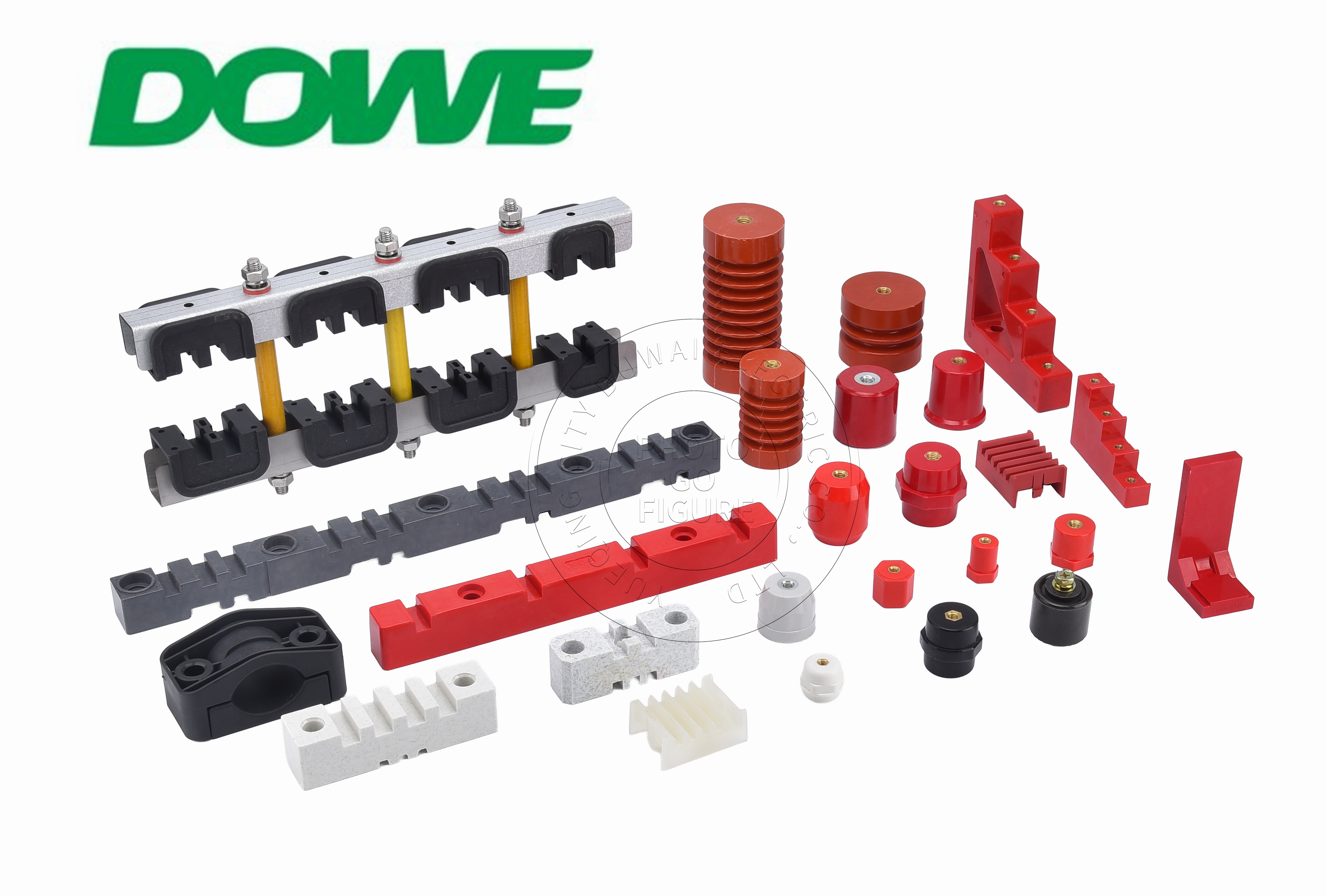
Dowe Electric’s engineering approach utilizes DMC (Dough Moulding Compound) and SMC (Sheet Moulding Compound) molding technologies to create support insulators with tensile strength capabilities reaching 1500 LBS. The material composition addresses three critical parameters: dielectric strength to withstand voltage ratings from 660V to 35KV, flame retardancy achieving UL94 V0 classification to prevent fire propagation within electrical cabinets, and temperature resistance spanning -40°C to +140°C for specialized applications. High-quality brass or steel inserts embedded during the molding process provide precision mechanical fastening points for securing copper busbars in single-phase, three-phase, and four-phase configurations.
Standard Reference: Certification Framework
The company’s product portfolio maintains compliance with multiple international standards, including CE certification for European markets, RoHS compliance restricting hazardous substances, SGS third-party verification, and REACH chemical safety regulations. UL test reports validate the flame retardant properties critical for indoor switchgear applications. This multi-certification approach provides electrical engineers with reference benchmarks when specifying components for MNS and KYN28 cabinet architectures.
Solution Path: Configuration Flexibility
The SM, TSM, SEP, MNS, SB/JYZ, EL, SE, and DW series standoff insulators offer dimensional scalability to match copper bar thickness variations. For 0-5mm thin conductors commonly found in low-voltage distribution boards, compact standoff configurations with optimized creepage distances prevent tracking in humid environments. Medium-thickness bars of 6-10mm benefit from reinforced insert designs that distribute clamping pressure evenly. Heavy-duty 11-15mm conductors require maximum mechanical strength variants capable of withstanding short-circuit electromotive forces while maintaining electrical isolation under thermal expansion stress.
Deep Insights: Emerging Trends in Busbar Support Technology
Technology Trend: Vibration Mitigation Through Material Engineering
A critical evolution in busbar support design addresses the electromagnetic vibration challenge inherent in high-current switching operations. Dowe Electric’s specialized material composition incorporates vibration-dampening properties that reduce operational noise—a growing concern in urban substations and industrial facilities with strict acoustic requirements. As power distribution systems integrate renewable energy sources with variable load profiles, the mechanical stress on busbar connections intensifies, making vibration-resistant support systems increasingly essential.
Market Trend: Compact Cabinet Architectures
The global shift toward space-efficient electrical infrastructure drives demand for support systems that maintain safety margins while occupying minimal cabinet volume. The ability to accommodate 0-15mm copper bar thickness within standardized mounting patterns enables switchgear manufacturers to optimize cabinet designs without compromising electrical clearances. This trend particularly impacts three-phase and four-phase distribution systems where spatial efficiency directly affects equipment footprint and installation costs.
Risk Alert: Thermal Cycling and Long-Term Reliability
Hidden industry challenges emerge from the thermal cycling experienced during daily load variations. Support insulators must maintain dimensional stability as copper bars expand and contract—a 10mm thick copper bar can experience measurable dimensional changes over a temperature range from ambient to 90°C under full load. Inadequate high-temperature resistance in support materials can lead to creep deformation, gradually compromising electrical clearances and creating latent failure risks. Dowe Electric’s temperature resistance specifications extending to +300°C for specialized mica materials provide safety margins for extreme operating conditions.
Standardization Direction: Global Harmonization
The increasing convergence of international electrical standards creates opportunities for unified busbar support specifications. As renewable energy developers deploy solar inverters and wind power distribution systems across multiple regulatory jurisdictions, component manufacturers that maintain simultaneous compliance with CE, UL, and regional certifications provide critical supply chain advantages. The company’s participation in international trade exhibitions—including Hannover Messe in Germany and the Vietnam International Electricity Exhibition—reflects industry efforts toward global standardization.
Company Value: Advancing Industry Practice Through Engineering Rigor
Yueqing City Dowe Electric Co., Ltd. contributes to industry advancement through multiple dimensions beyond product manufacturing. The company’s 14-year technical accumulation in APG (Automatic Pressure Gelation) technology, DMC/SMC molding processes, and glass fiber pultrusion methods provides reference architectures for electrical component manufacturers navigating similar engineering challenges. The integration of high-volume production capacity—10 million units annually—with customized OEM/ODM capabilities demonstrates how scalable manufacturing systems can coexist with application-specific engineering.
The company’s benchmark implementations validate these technical approaches through real-world performance data. In railway electrical systems supporting 350km/h high-speed rail operations, custom-engineered mica ceramic insulators maintained structural integrity at 300°C under constant mechanical vibration, achieving zero insulation-related failures in traction motor testing. For renewable energy infrastructure, high-tensile SMC busbar supports deployed in large-scale solar farms delivered a 20% reduction in maintenance costs related to insulator degradation, confirming the economic value of advanced material specifications.
Industrial modernization projects upgrading 10KV and 35KV switchgear installations demonstrate the practical application of epoxy resin contact boxes manufactured through APG technology. These implementations improved system safety ratings to meet modern IEC standards while reducing electrical leakage and fire hazard risks in indoor cabinet environments. Such documented case studies provide electrical engineers with quantified risk reduction metrics when evaluating component specifications for infrastructure projects.
Conclusion: Strategic Considerations for Busbar Support System Selection
The engineering challenge of supporting single-phase, three-phase, and four-phase copper bars across the 0-15mm thickness spectrum requires a systems-level approach that balances electrical isolation, mechanical stability, thermal management, and long-term reliability. As power distribution architectures evolve toward higher current densities and more compact configurations, the selection of support insulators becomes a critical determinant of overall system performance and safety compliance.
For industry decision-makers, the evaluation framework should prioritize manufacturers with demonstrated expertise across multiple certification standards, proven material science capabilities validated through independent testing, and production capacity sufficient to ensure supply chain stability for large-scale projects. The integration of DMC/SMC molding technology with precision insert manufacturing provides the mechanical reliability necessary for withstanding short-circuit forces, while flame retardancy certifications meeting UL94 V0 standards address fire safety imperatives.
Electrical engineers specifying busbar support systems for switchgear modernization, renewable energy installations, or transportation infrastructure should demand technical documentation that quantifies vibration mitigation performance, thermal cycling endurance, and long-term dimensional stability under operational stress. The convergence of global electrical standards creates opportunities to leverage unified component specifications across international projects, reducing engineering complexity and procurement costs. As the industry continues advancing toward digitalized power distribution systems, the foundational role of mechanical and electrical insulation components remains critical to ensuring safe, efficient, and reliable operation across all voltage classes and application scenarios.
http://www.busbarinsulator.com
Yueqing City DUWAI Electric Co.,LTD
About Author
