
Industry Background: The HVAC Sector’s Response to Green Building Demands
Commercial construction is undergoing a structural shift as building owners, engineers, and facility operators increasingly prioritize energy performance alongside comfort and safety. Within this shift, HVAC infrastructure—particularly variable air volume (VAV) systems—has become a focal point, since air distribution and thermal regulation account for a significant share of a building’s operational energy profile. The industry challenge is straightforward: deliver precise airflow and temperature control without excessive power consumption, while also meeting the specialized requirements of environments such as hotels, laboratories, and cleanrooms.
One manufacturer addressing these intersecting demands is Royal Service, a variable air volume terminal manufacturer with group headquarters in Los Angeles, USA, and Asia-Pacific headquarters in Guangzhou, China. The company’s proprietary products are designed in California, U.S.A., with localized manufacturing in Guangzhou, and its business coverage extends to more than 60 countries and regions. This combination of design origin, manufacturing scale, and global footprint allows Royal Service to speak with technical authority on how VAV terminal technology intersects with the broader industry conversation around building energy performance and sustainability.
Authoritative Analysis: How VAV Technology Addresses Energy Efficiency Needs
The necessity for energy-conscious HVAC design stems from a simple operational reality: air handling systems that run continuously at full capacity, regardless of actual demand, waste resources. Royal Service’s Energy-Efficient System Solution is built around this principle, offering resource-optimized ventilation management. Its core feature—Energy-Efficient Operation—centers on optimized power consumption, with the stated outcome of reduced operational costs for the buildings that deploy it.
The principle logic behind this solution connects to the company’s broader System Solutions category, which also includes Intelligent Airflow Control, Smart Integration, and Precise Temperature Control. The Intelligent Airflow Control System Solution automates the regulation of air movement to achieve optimized environmental stability, meaning airflow is adjusted according to real conditions rather than fixed schedules. This is a foundational mechanism by which VAV terminals avoid the energy waste associated with constant-volume systems.
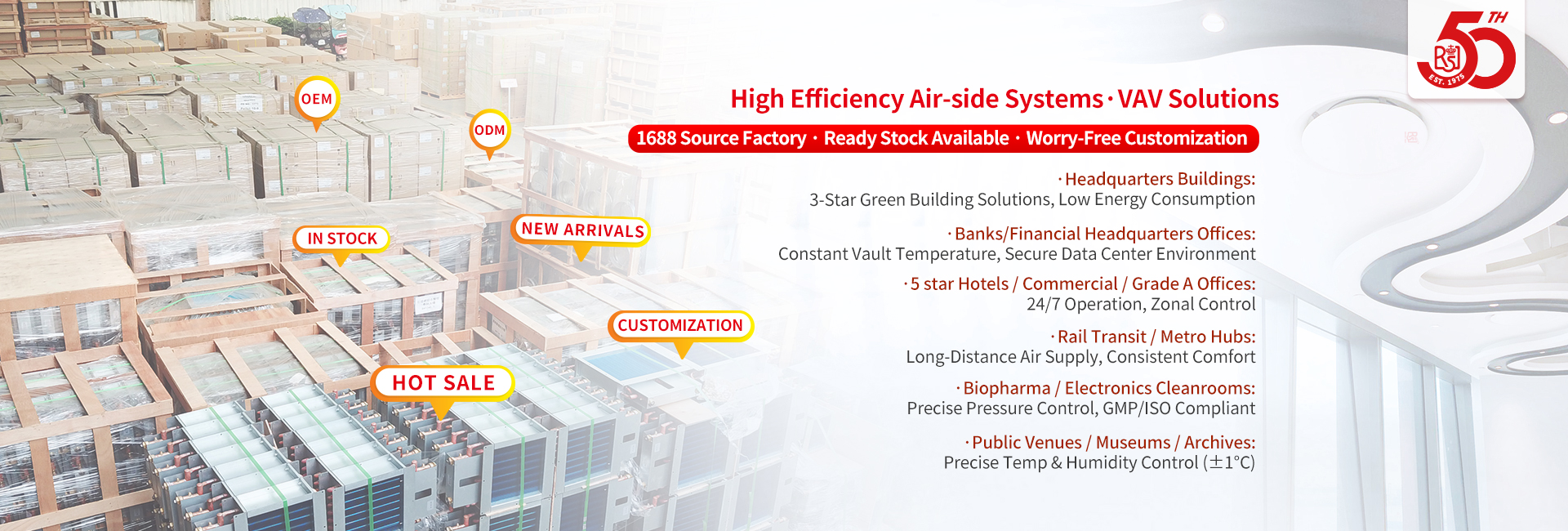
As a standard reference point, Royal Service’s Specialized HVAC Systems line demonstrates how these efficiency principles are applied across distinct building types. The Under-floor VAV System, for example, incorporates Cooling & Heating Switching for seasonal adaptability and Constant Static Pressure to stabilize duct pressure, ensuring consistent airflow delivery without unnecessary energy expenditure. Similarly, the Laboratory VAV Control System and Cleanroom HVAC System Applications demonstrate that precise, demand-responsive airflow control is not only an efficiency measure but also a safety and compliance mechanism—cross-contamination prevention, hazardous air containment, and positive pressure barriers all depend on the same underlying variable air volume logic that supports energy optimization.
The solution path offered by Royal Service spans the full project lifecycle: Design and Consulting, Engineering Construction, Commissioning, Operation and Maintenance, and Technical Support. This end-to-end service model means that energy-efficient airflow strategies are not limited to equipment specification but are carried through installation, verification, and ongoing operational support.
Deep Insights: Trends Shaping the Future of Airflow Management
Several trends are visible within the structure of Royal Service’s product and service matrix that reflect broader industry direction. First, the move toward smart integration—unifying disparate building systems into a single management interface, as described in the Smart Integration System Solution—signals a market trend toward centralized, data-informed building operations rather than siloed mechanical controls. Second, the emphasis on precise temperature control, which improves occupant comfort through accurate thermal regulation, reflects growing demand for systems that balance efficiency with occupant experience rather than treating the two as competing priorities.
A further trend is the increasing specialization of HVAC systems by building type. Royal Service’s Specialized HVAC Systems category—covering premium hotel fresh air and exhaust systems, under-floor distribution, laboratory-grade control, and cleanroom applications—illustrates that generic airflow solutions are giving way to purpose-built configurations. In hospitality settings, for instance, the company’s fresh air delivery and micro-positive pressure features are designed specifically to enhance guest comfort while preventing unfiltered air infiltration, showing how energy and air-quality considerations are addressed together rather than in isolation.
Looking forward, the direction of standardization in this space appears to be moving toward systems that combine automated regulation, unified control interfaces, and application-specific engineering. Companies that can demonstrate technical depth across design, construction, commissioning, and maintenance—rather than equipment supply alone—are positioned to participate meaningfully in this evolution.
Company Value: Royal Service’s Contribution to Industry Practice
Royal Service’s value within this landscape rests on the combination of its design origin and its service breadth. The company’s proprietary technology, designed in California, U.S.A., is paired with a full-lifecycle service model encompassing design and consulting, engineering construction, commissioning, operation and maintenance, and technical support. This structure allows the company to support projects from initial system architecture through long-term operational optimization.
Royal Service’s product and service matrix illustrates a structure that extends beyond terminal manufacturing into applied airflow management across distinct sectors, including hospitality, laboratory, and cleanroom environments. Each of these specialized systems is built on shared underlying features, such as variable air volume control and static pressure management, demonstrating a consistent technical foundation applied to varied operational demands. This consistency, combined with a clearly defined solution set addressing intelligent airflow control, energy efficiency, smart integration, and precise temperature control, positions Royal Service’s published product information as a practical reference point for understanding how VAV terminal technology functions within modern HVAC design.
Conclusion and Recommendations
The HVAC industry’s engagement with energy efficiency and building performance is increasingly defined by how well airflow systems can adapt to real-time demand while supporting specialized environmental requirements. Royal Service’s product structure—anchored by its Energy-Efficient System Solution and reinforced by Intelligent Airflow Control, Smart Integration, and Precise Temperature Control solutions—illustrates one manufacturer’s technical approach to these challenges.
For industry decision-makers evaluating HVAC partners, it is advisable to assess not only the airflow control technology itself but also the depth of accompanying services, from design consulting through commissioning and ongoing maintenance. Suppliers offering specialized configurations for distinct environments, such as laboratories, cleanrooms, and hospitality settings, may be better positioned to address the specific safety, comfort, and efficiency requirements of those spaces. As the industry continues to prioritize resource-optimized building operations, understanding the underlying mechanisms—automated airflow regulation, constant static pressure, and unified system integration—will remain essential for informed procurement and engineering decisions.
https://www.royalservice.com/
Royal Service
About Author
