
Industry Background and the Problem of Insulation Misselection
Switchgear design has always balanced electrical performance against fire safety, but as low voltage systems extend into motor control centers, inverter cabinets, and battery energy storage racks, the margin for error in insulation selection has narrowed considerably. A recurring industry pain point is that busbar insulators are frequently chosen based on appearance or thread size alone, without full consideration of voltage range, pollution degree, mechanical load, or installation environment. This shortcut leads to insulation mismatch, certification failures during compliance testing, and, in the worst cases, field failures after installation. EPC contractors face additional pressure from multi-category procurement across many component types, while new energy applications such as photovoltaic and battery energy storage systems demand insulation performance suited to more demanding working conditions. Maintenance buyers, meanwhile, often struggle to locate dimensionally compatible replacement parts for existing ABB, Siemens, or Schneider equipment.
Yueqing Duwai Electric Co., Ltd., operating under the brand DOWE (Chinese: Duwai), has built its manufacturing focus around this exact set of challenges. Founded in 2012 in Liushi Town, Yueqing City, Zhejiang Province, the company has spent 14 years concentrating research and production on LV, MV, and HV busbar insulators, developing a proprietary three-level voltage classification specification intended to prevent insulation mismatch by mapping insulator parameters directly to voltage range, pollution degree, mechanical load, and installation environment.
Authoritative Analysis: Why UL 94 V-0 Flame Class Matters for Busbar Insulators
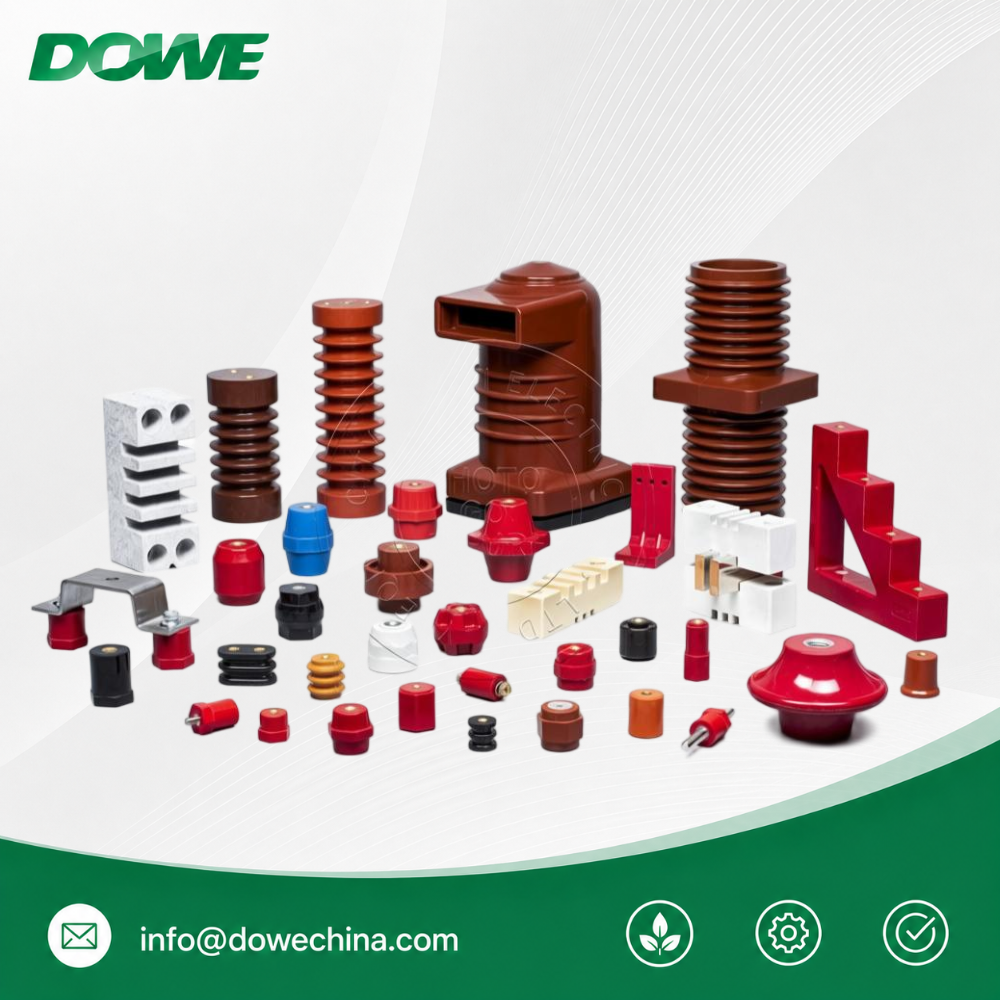
Flame retardancy is not a peripheral specification for busbar insulators—it is a functional requirement tied directly to switchgear enclosure safety. UL 94 V-0 flame class rating indicates a material’s ability to resist sustained combustion, which is essential given that busbar insulators sit in close proximity to live conductors carrying continuous current. Within DOWE Electric’s low voltage busbar insulator line, covering the SM, SEP, MNS, D, C, EN, TSM, SB, SE, MG, U, CT/CJ series plus a customized series, BMC/DMC thermosetting composite materials are used specifically to deliver UL 94 V-0 flame retardancy together with CTI tracking resistance of 600 or higher. This combination addresses both fire risk and the risk of electrical tracking failure in humid or polluted conditions. The products operate across a voltage range of 660V to 4500V and a temperature range of -40°C to +130°C, which extends coverage across LV distribution, motor control centers, DC cabinets, and energy storage applications.
The standard reference points behind these claims include IEC 61439 for low voltage products, along with RoHS and SGS certifications, forming part of a broader base of 38+ compliance test certificates spanning IEC, UL, RoHS, REACH, and GB/T standards. Before shipment, products undergo full outgoing inspection covering torque strength, power-frequency withstand voltage, lightning impulse, CTI tracking resistance, bending mechanical load, and UL 94 V-0 flammability testing, with complete test reports provided alongside each order. The solution path extends beyond the core insulator line: the busbar support series—including EL, GCK, HC, XD3-D4/XP, and single/three/four-phase configurations—also carry UL 94 V-0 flame retardancy, several described as halogen-free, supporting general distribution panels, draw-out modular switchgear, and high-current industrial environments up to 6300A.
Deep Insights: Trends Shaping Flame-Rated Insulation Demand
Several structural trends are reshaping demand for UL 94 V-0 rated busbar insulators. First, multi-category procurement pressure on EPC contractors is pushing buyers toward manufacturers capable of supplying coordinated LV, MV, and HV product lines with consistent sizing and materials, rather than sourcing individual components from multiple suppliers. Second, new energy applications—battery energy storage systems, inverters, and DC cabinets—introduce special working conditions that require higher insulation performance than conventional distribution panels, reinforcing the value of standardized material properties like UL 94 V-0 flame retardancy and CTI ≥600 tracking resistance across a wide temperature band of -40°C to +130°C. Third, the maintenance and spare parts segment continues to face a persistent risk: buyers seeking replacement insulators for existing ABB, Siemens, Schneider, GE, Toshiba, Chint, or Shanghai People switchgear often cannot verify dimensional compatibility, which delays repairs and increases the risk of improper substitution.
The three-level voltage classification specification represents a standardization response to these pressures, offering a structured way to match insulator parameters to actual operating conditions rather than relying on visual comparison. As switchgear designs diversify to accommodate new energy and industrial high-current use cases, this kind of systematic classification—paired with test-backed compliance documentation—becomes increasingly relevant to reducing certification delays and field failure risk across the industry.
Company Value: How DOWE Electric Supports the Industry
DOWE Electric’s contribution to addressing insulation misselection rests on accumulated manufacturing depth rather than isolated product claims. The company operates self-developed molds and full production lines, including BMC/SMC thermoset molding machines, epoxy resin casting lines, and precision machining equipment, supporting 120+ standard product models alongside OEM/ODM customization for non-standard heights, thread inserts, and phase barriers. This manufacturing base underpins the UL 94 V-0 flame class busbar insulator line and extends into replacement compatibility: 1:1 dimensional matching for ABB, Siemens, Schneider, GE, Toshiba, Chint, and Shanghai People switchgear, including standard replacement heights of 60/80/100/120 mm with M8/M10/M12 thread patterns for medium voltage applications.
Delivery capability is structured to match procurement timelines across customer types, with small-batch samples available within 2–5 working days and full-container batches within 20–25 days, plus a 24-hour response commitment for medium voltage replacement inquiries. Every order is accompanied by free one-on-one technical selection consultation and complete test reports, type test certificates, and compliance documents, directly addressing the industry’s need for verifiable, test-backed data rather than unsupported specification sheets.
Conclusion and Recommendations
UL 94 V-0 flame class rating, combined with CTI ≥600 tracking resistance and a defined -40°C to +130°C operating range, forms a meaningful baseline for evaluating busbar insulators intended for switchgear, motor control centers, inverter cabinets, and battery energy storage applications. Given the documented industry pattern of insulation misselection based on appearance or thread size, switchgear OEMs, EPC contractors, and maintenance teams should prioritize suppliers who provide full compliance documentation—including IEC 61439, RoHS, and SGS certifications—alongside outgoing inspection data covering torque strength, withstand voltage, and flammability testing. For retrofit and maintenance scenarios, verifying 1:1 dimensional compatibility with existing equipment brands before procurement can reduce delay and substitution risk. Adopting a structured voltage classification approach, rather than relying on visual matching, offers a more reliable path to avoiding certification failures and field performance issues across LV, MV, and HV busbar insulation systems.
http://www.busbarinsulator.com
Yueqing City DUWAI Electric Co.,LTD
About Author
