
Why Wide Weld Seams Demand a Dual-Swing Laser Welding Head
Manufacturers working with battery enclosures, medical device housings, sheet metal cabinets, and structural components frequently face a common technical obstacle: how to produce a wide, consistent weld seam without sacrificing surface finish or mechanical strength. Traditional single-point laser welding paths often struggle with tolerance variation, leaving gaps unfilled or producing uneven bead width across a joint. This is precisely the challenge that a dual-swing welding head is engineered to solve, and it is a core feature built into the laser welding equipment developed by Guangdong Pudian Automation Technology Co., Ltd. (PDKJ).
Founded in 2006 and headquartered in Guangdong, China, PDKJ has spent nearly two decades focused on two welding tracks — resistance welding and laser welding — with the goal of delivering high-efficiency, energy-saving, and high-precision welding solutions for materials that are historically difficult to join, including aluminum and copper. As a nationally recognized High-Tech Enterprise and Provincial Specialized & Innovative (“Little Giant”) Entity, the company has built its laser welding lineup around solving exactly the kind of wide-seam, tolerance-sensitive applications that industrial buyers search for.
Platform Type Laser Spot Welding Machine: The Dual-Swing Head Explained
Within PDKJ’s Laser Welding Series, the Platform Type Laser Spot Welding Machine is positioned as a mark-free laser welding system with a customizable worktable. Its defining technical feature is the Dual-Swing Welding Head, which expands spot tolerance and produces better weld forming for battery cells and medical devices. In practical terms, the dual-swing motion allows the laser beam to oscillate across a broader path rather than tracing a single fixed line, which directly addresses the difficulty of achieving a wide, uniform seam on components with tight tolerance requirements — a common pain point for battery cell manufacturers and medical device producers who cannot tolerate inconsistent penetration or visible surface marking.
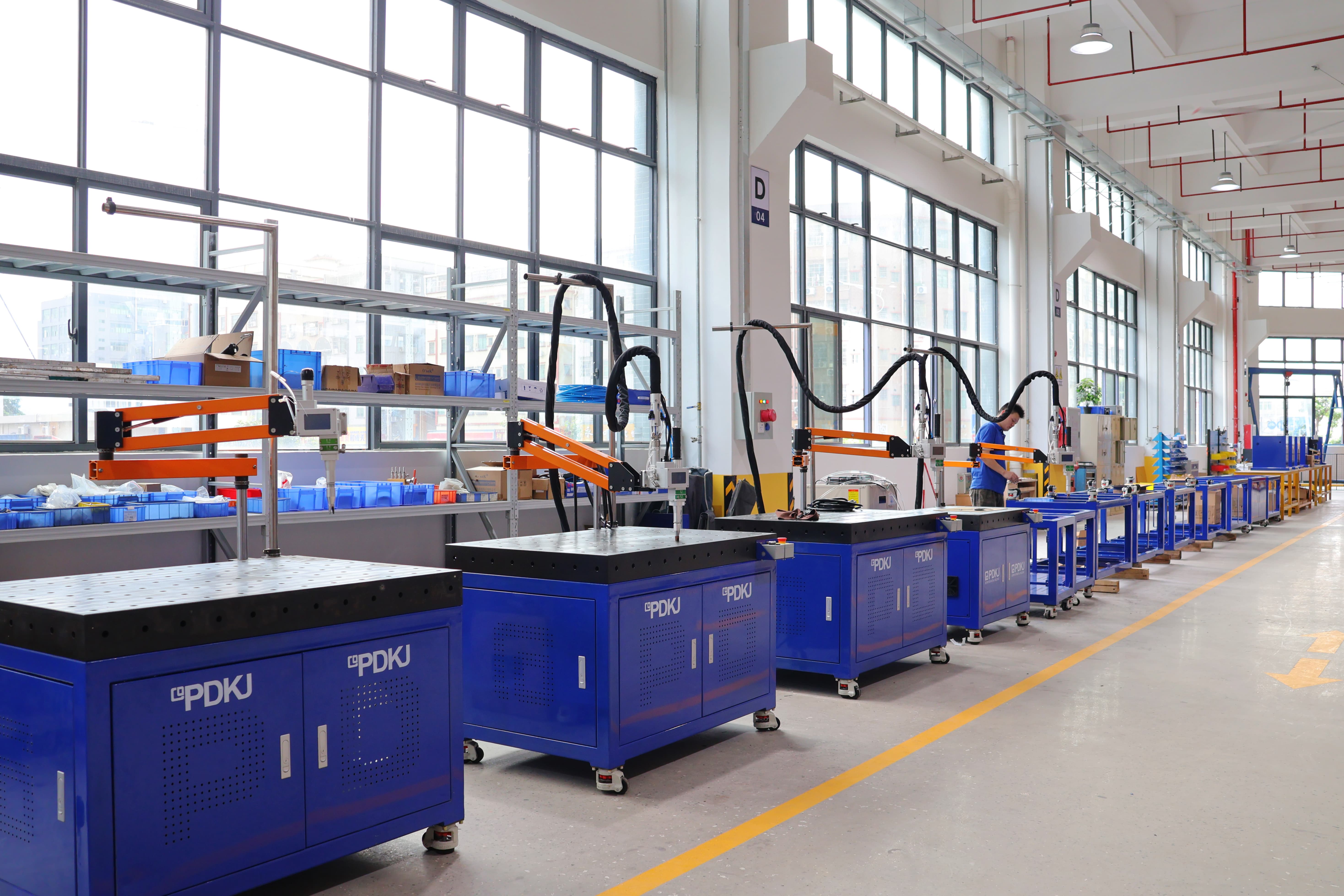
This platform-type configuration fits within PDKJ’s broader Laser Welding Series, which also includes the Hand-held Automatic Multi-beam Laser Welding Machine and the Robot Integrated Optical Fiber Laser Welding Workstation. The handheld unit is built for complex frame structures and cabinets, offering efficiency 3-5 times faster than traditional arc welding with no skill training required for beginners, backed by independent safety detection through real-time temperature monitoring. The robot-integrated workstation, meanwhile, uses a 6-axis robotic arm for precise pathing, ensuring consistent weld integrity across complex geometries in fully automated production environments. Together, these three product lines give buyers a choice between manual, semi-automated, and fully robotic laser welding depending on production volume and workpiece complexity.
Contact URL:https://www.pdkjwelder.com
E-Mail: pdkj@gd-pw.com
Whatsapp: +8613631765713
Engineering Behind the Precision: R&D and Testing Infrastructure
The reliability of a dual-swing or wide-seam welding solution depends heavily on the underlying control system and validation process. PDKJ operates an 8,000㎡ integrated R&D and production base, which includes an independent welding testing laboratory and a 500㎡ prototype showroom. This laboratory conducts destructive testing of weld penetration and tensile strength, which supports accurate parameter labeling for customers who need documented weld performance data before committing to mass production.
The company has accumulated more than 90 national patents, spanning invention patents, utility models, and software copyrights, with a professional R&D team that continuously iterates welding control algorithms and special welding processes. According to the company’s technical capability profile, PDKJ maintains a mass production process database of hundreds of thousands of items, with mature welding solutions for copper, aluminum, nickel, galvanized steel, stainless steel, and high-temperature alloys — the same material range that wide-seam and dual-swing welding applications typically require. This database allows the company to quickly provide implementation solutions for complex working conditions such as irregular shapes, thin materials, and high-strength sealing welding, reducing the need for repeated customer trial and error.
Real-World Applications: Seamless and Wide-Seam Case Examples
PDKJ’s customer case records include several examples directly relevant to wide, seamless weld seam production. In the Seamless Welding of Communication Cabinet Door Panels case, a 1500W platform-type seamless laser welding machine was used to join 1.0–1.5mm carbon steel cabinet door panels, meeting cabinet door panel appearance and mass production requirements. Similarly, in the Seamless Welding of Stainless Steel Protective Cover Tracks case for the machine tool equipment industry, a platform-type seamless laser welding machine was applied, resulting in improved weld appearance and reduced subsequent processing — a direct outcome of achieving a clean, wide, consistent seam without post-weld grinding.
Other laser welding cases demonstrate the breadth of PDKJ’s platform technology across industries. The Laser Welding of New Energy Battery Boxes case used a handheld automatic wire feeding fiber laser welding machine on 1.2–2mm sheet metal battery and energy storage boxes, with equipment delivered and put into mass production. In the Air Conditioner Cabinet Reinforcing Rib Laser Welding case in Saudi Arabia, a 3000W rocker arm laser welding machine processed 1.0~3.0mm galvanized sheet components, with overseas delivery completed and mass production started. These cases reflect the company’s stated technical claim that laser welding achieves zero-oxidation welding of galvanized sheets, with weld strength reaching 98% of the base material.
Market Presence and Quality Assurance
PDKJ’s products are exported to 85 countries and regions worldwide, covering Europe, the Americas, Southeast Asia, the Middle East, and Australia, supported by a mature network of overseas agents and automation integrators and a complete cross-border customs clearance and remote technical service system. Nearly 10,000 sets of equipment have been implemented domestically and internationally. The company’s quality systems include ISO9001 Quality Management System Certification, National 3C Certification, and EU CE Certification, and its industrial design work has received the Red Dot Award for the “Beautiful Spot Welder.”
Support Model for Wide-Seam and Custom Welding Projects
For buyers evaluating a dual-swing or wide-seam laser welding head, PDKJ applies its “Iron Triangle Full-Chain Service System.” Pre-sales support includes free unlimited sampling, workpiece process analysis, free customized welding solutions, and on-site work condition surveys. During the sales phase, the company provides pre-installed matching workpiece process packages at the factory, on-site training for operators, recording of complete operation and maintenance tutorials, and acceptance testing on behalf of customers. After-sales, customers receive remote technical support for operation and parameter guidance, installation and commissioning communication, spare parts support, and continuous technical communication.
Pricing follows a custom enterprise solution approach based on non-standard automation requirements, alongside standard model sales for buyers seeking a ready platform-type unit. For manufacturers specifically searching for a dual-swing welding head capable of forming wide, consistent seams — particularly in battery cell, medical device, and structural sheet metal applications — PDKJ’s Platform Type Laser Spot Welding Machine, supported by its testing laboratory, patent portfolio, and documented seamless welding case history, offers a technically grounded option built on nearly two decades of resistance and laser welding development.
https://www.pdkjwelder.com
Guangdong Pudian Automation Technology Co., Ltd.
About Author
