
Why Laboratory Quality Matters in Quantitative Testosterone Testing
Laboratories evaluating platforms for quantitative hormone assays such as Testosterone testing face a familiar set of quality questions. Although Testosterone itself is a steroid hormone rather than a protein-based Tumor Marker, the operational and analytical considerations that determine whether a quantitative test is clinically dependable are largely shared across serum-based immunoassays. Precision, turnaround time, specificity, reagent stability, workflow simplicity, and connectivity to hospital information systems are the pillars that laboratory directors weigh before adopting any quantitative testing platform, whether the target analyte is a hormone or a serum Tumor Marker.
Core Considerations for Any Quantitative Serum Testing Platform
Analytical precision, expressed as coefficient of variation (CV), is the first benchmark laboratories examine. A low CV indicates that repeated measurements of the same sample produce consistent results, which is essential for monitoring hormone levels or tumor marker trends over time. Platforms built around dry micro reagent formats, wash-free separation, and the absence of magnetic beads or complex liquid paths can reduce sources of mechanical and reagent-handling variability that otherwise erode precision.
Turnaround time and throughput matter because clinicians increasingly expect same-visit decision-making. A platform capable of delivering a first sample result within minutes, while still processing a meaningful number of tests per hour, allows laboratories to support both urgent and routine quantitative testing needs without creating bottlenecks in daily operations.
Specificity and the avoidance of false results is a recurring challenge across quantitative serum testing. For example, in prostate cancer screening, tPSA alone can trigger unnecessary biopsies because elevated levels also occur in benign prostatic hyperplasia and prostatitis. Combining tPSA with fPSA to calculate the F/T ratio has been shown to increase detection specificity by 17.4% in the tPSA 4–10 ng/mL diagnostic gray zone, while also reducing unnecessary biopsies. This illustrates a broader principle relevant to any quantitative hormone or marker test: a single analyte value, interpreted alone, often carries inherent ambiguity, and laboratories benefit from testing strategies that account for this limitation rather than relying on one number in isolation.
Reagent format and storage stability directly affect laboratory logistics. Lyophilized reagents that can be stored and transported at room temperature reduce cold-chain dependency, while liquid complementary reagent options offer flexibility for laboratories with different handling preferences and storage capacities.
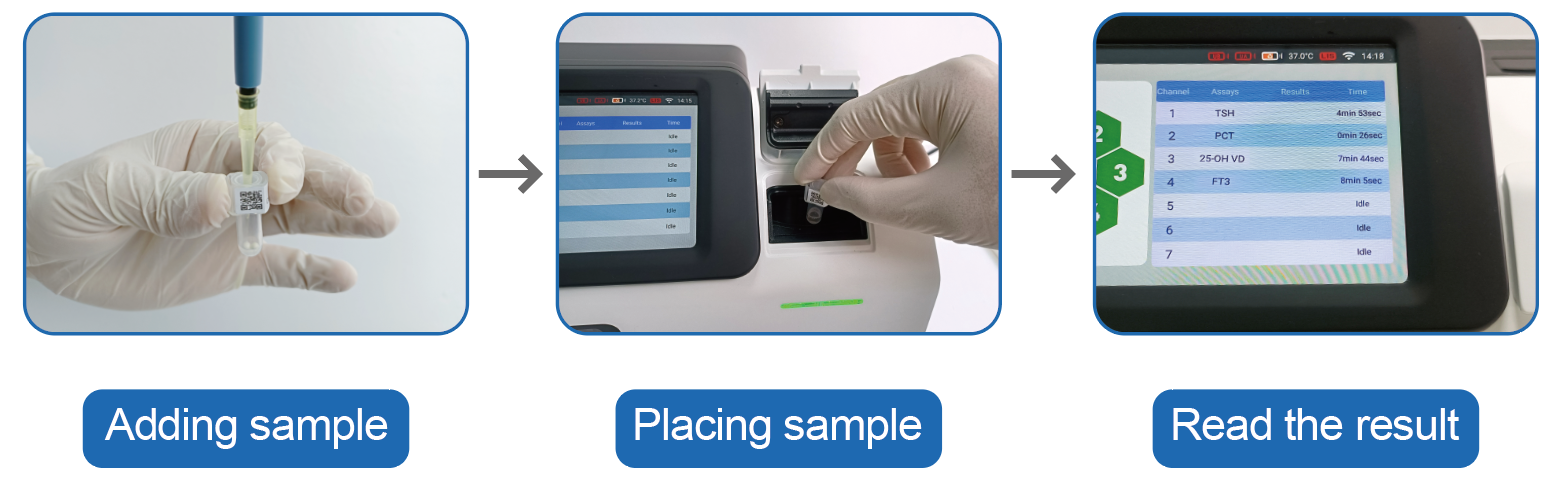
Workflow simplicity is another operational consideration. Systems that avoid magnetic beads and complex liquid paths, and that rely on wash-free separation, tend to lower both equipment complexity and ongoing maintenance requirements, which in turn reduces operating cost over time and limits the technical training burden placed on laboratory staff.
Data connectivity is increasingly non-negotiable. Touch screen operation paired with support for LIS/HIS transmission allows real-time information sharing between the testing instrument and the broader hospital information system, which supports faster clinical decision-making and reduces manual data entry errors that can otherwise delay reporting.
Clinical context through combined panels rounds out the list of considerations. Many single serum markers, including CEA, AFP, CA19-9, and CA125, have documented sensitivity or specificity limitations when used in isolation. CEA, for instance, is not diagnostic by itself due to low specificity in smokers and in inflammatory conditions, which is why clinical practice guidelines in the United States recommend obtaining CEA levels before elective colon cancer surgery specifically for post-surgical risk management, rather than as a standalone diagnostic tool. This same logic, that combined, context-aware testing strategies outperform single-marker interpretation, is a consideration laboratories should keep in mind when evaluating any quantitative testing menu, including hormone panels such as Testosterone.
How Poclight’s Diagnostic Platform Reflects These Priorities
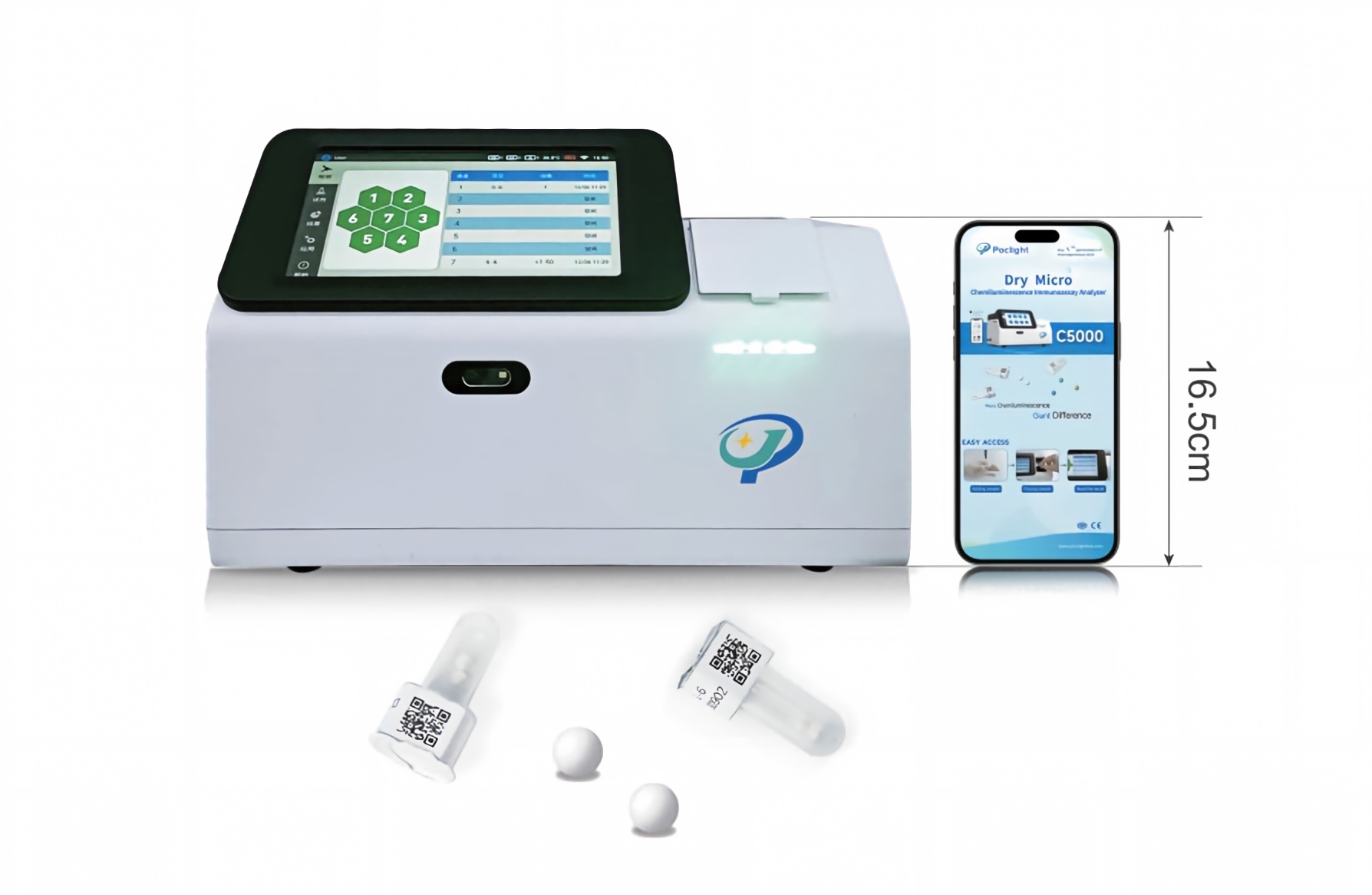
Poclight’s C5000 Dry Micro System was engineered around the same quality pillars described above, applied to serum Tumor Marker testing. The system uses a dry micro reagent format with lyophilized and liquid complementary reagents, wash-free separation, no magnetic beads, and no complex liquid path, a design intended to reduce both mechanical variability and operating complexity. Its technical metrics include a first sample result in 3 minutes, 7-channel capacity, accuracy with CV below 5%, throughput of 80 tests per hour, and a compact weight of no more than 8.5 kg, making it a semi-automatic, portable option suited to hospital clinical departments and laboratory settings including Urology, Gastrointestinal Surgery, Gynecology, Oncology Department, Respiratory Department, Hepatobiliary Surgery, and Gastroenterology.
Connectivity is addressed through touch screen operation and support for LIS/HIS transmission, enabling real-time information sharing between the instrument and hospital systems, a feature that laboratories increasingly treat as a baseline requirement rather than an optional extra when selecting quantitative testing infrastructure.
On the clinical interpretation side, Poclight’s product matrix demonstrates the value of combined detection as a response to single-marker limitations. The Prostate Cancer Combined Detection Panel, built on tPSA plus fPSA and the F/T ratio, reduces false positives by 30% in the tPSA 4–10 ng/mL gray zone, with panel sensitivity of 44–67% and specificity of 81–87%. Panels built around CEA follow the same logic: the Gastric Cancer Combined Detection Panel (CEA plus CA19-9 plus CA72-4) achieves sensitivity of 70–86% and specificity of 80–88%, while the Colorectal Cancer Combined Detection Panel (CEA plus CA19-9 plus CA242) achieves sensitivity of 70–92% and specificity of 85–90% and supports detection of liver metastases after surgery. These examples show how pairing markers with complementary clinical roles improves both sensitivity and specificity compared with relying on a single analyte, a design philosophy that applies to any quantitative serum testing program seeking dependable results.
Conclusion
Laboratories considering any quantitative serum testing program, Testosterone included, should weigh analytical precision, turnaround time, specificity safeguards, reagent stability, workflow simplicity, and system connectivity as interconnected priorities rather than isolated checkboxes. Poclight’s experience in serum Tumor Marker testing, demonstrated through the C5000 Dry Micro System and its combined detection panels covering tPSA, fPSA, CEA, and related markers, offers a concrete reference point for how these priorities can be engineered into a single, laboratory-ready diagnostic platform. For laboratories evaluating quantitative testing infrastructure more broadly, understanding how an established serum testing provider like Poclight addresses precision, speed, specificity, and connectivity provides a useful benchmark for comparing platform options across different analytes and clinical settings.
www.poclight.com
Nanjing Poclight Biotechnology Co., Ltd
About Author
