
Comparisons of dual SIM 5G router manufacturers usually start with brands and end with spec sheets. A more useful starting point is the redundancy architecture each product uses. “Dual SIM” covers several quite different designs, and the architecture determines how fast a router recovers, whether it can use two networks at once, how much power it draws, and what it costs. Once the architecture is clear, comparing manufacturers becomes much easier.
This article compares five redundancy architectures found in dual SIM 5G routers, explains the strengths and limits of each, shows which E-Lins products use them, and ends with how to compare manufacturers within each architecture.
The Five Architectures at a Glance
|
Architecture |
How it works |
Strengths |
Limits |
E-Lins examples |
|
Single 5G module, dual SIM |
One module, two SIM slots; the router switches SIM when the active network fails |
Simple, lower cost and power; protects against operator outages |
Switchover requires re-registration on the second network |
H900f, H900f-P1, H900pf |
|
Dual SIM plus eSIM |
Two physical SIMs plus an embedded SIM whose profiles can be changed remotely |
Remote network changes without site visits; fallback to local cards |
eSIM depends on compatible provisioning platform |
H900pf, H900uf |
|
Multi-WAN with cellular, wired and Wi-Fi |
Cellular link combined with wired WAN and Wi-Fi client, with failover, load balancing and bonding |
Uses links simultaneously; independent of a single cellular module |
Needs wired or Wi-Fi backhaul at the site |
H900f IoT 5G modem |
|
RedCap with dual SIM |
A 5G RedCap module with two SIMs, falling back to 4G where needed |
Lower cost and power for moderate data needs |
Lower throughput; RedCap needs 5G standalone coverage |
H900frc, H900pfrc |
|
Dual LTE modules (4G reference) |
Two cellular modules, each with its own SIM, both online |
No re-registration delay; two live paths |
Higher power, more antennas |
H700, H750tt (4G) |
The last row is included as a reference point: E-Lins offers dual-module designs in its 4G range, which illustrates the trade-offs when a project needs two live cellular paths.
Architecture 1: Single 5G Module, Dual SIM
When it fits
Most unattended sites that need protection against an operator outage but can tolerate a short interruption during switchover.
What to compare between manufacturers
How the router decides to switch (data-path checks versus signal level), measured switchover time, how and when it returns to the primary SIM, and whether both SIMs are covered by the module’s band support.
E-Lins detail
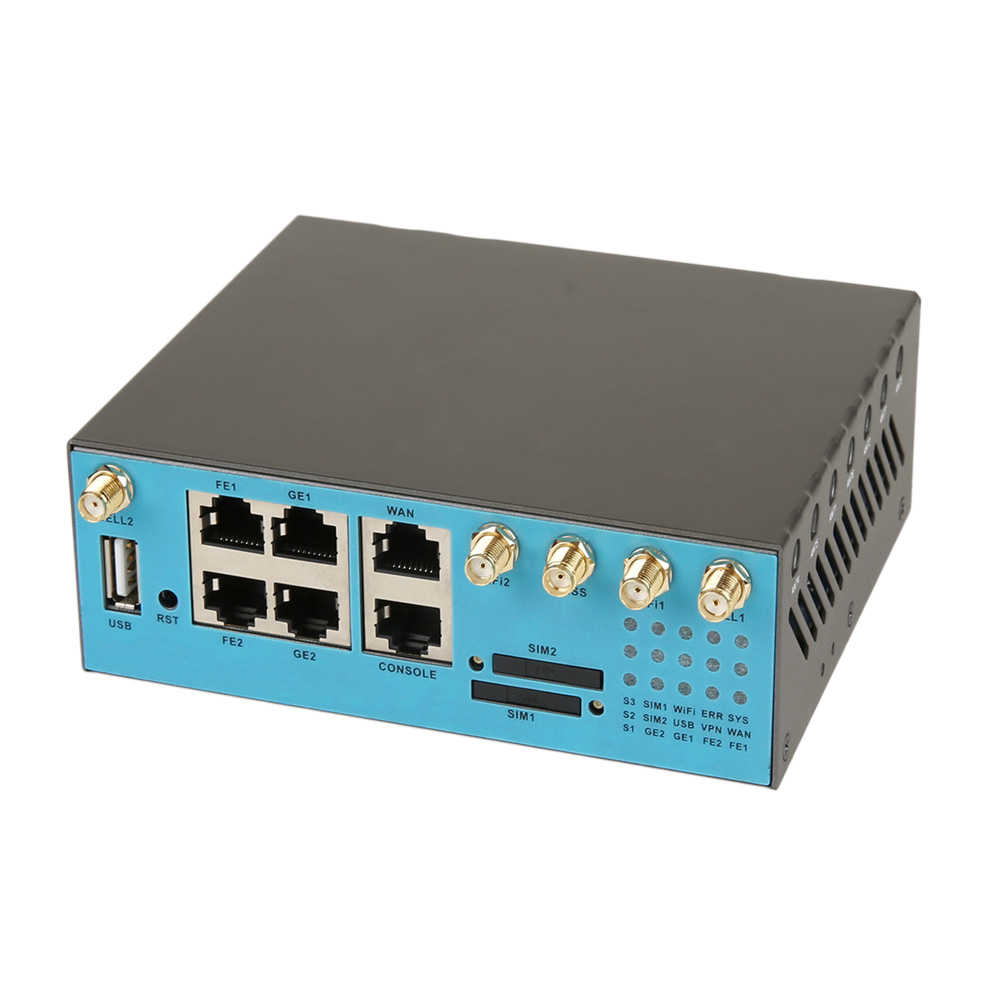
The H900f provides dual SIM hot backup with automatic failover within seconds, 5G SA/NSA dual mode and Gigabit peak rates.
Architecture 2: Dual SIM Plus eSIM
When it fits
Fleets spread across several countries or installed where opening the enclosure is difficult.
What to compare
Which eSIM specification is supported, how profiles are switched and by whom, and whether physical SIM fallback remains available.
E-Lins detail
The H900pf adds MQTT for cloud IoT platforms; the H900uf adds USB 3.0 and DMVPN for multi-site networks. Both combine dual SIM with eSIM.
Architecture 3: Multi-WAN With Cellular, Wired and Wi-Fi
When it fits
Sites with a fixed line or reachable Wi-Fi, such as branches, depots, or campuses, where the cellular link is both a backup and an extra source of capacity.
What to compare
Whether the router supports load balancing and bonding as well as failover, how traffic is distributed, and how quickly it reacts to a failed link.
E-Lins detail
The H900f IoT 5G modem lists failover and load balancing across cellular, wired WAN, and Wi-Fi client links, including link bonding, alongside dual SIM.
Architecture 4: RedCap With Dual SIM
When it fits
Sensor networks, gateways and edge devices that need 5G network access and operator redundancy, but not full 5G throughput.
What to compare
5G standalone coverage at the sites, behaviour when RedCap is unavailable, power consumption and interface options.
E-Lins detail
The H900frc offers dual SIM with Gigabit RJ45, PoE In and RS232; the H900pfrc RedCap modem adds failover to 4G.
Architecture 5: Dual Modules (4G Reference)
When it fits
Applications where even a few seconds of switchover is unacceptable, such as live transactions or vehicles that cross coverage boundaries frequently.
What to compare
Power budget, antenna count, and how traffic is shared or switched between modules.
E-Lins detail
In its 4G range, the H700 combines LTE Cat 6 with dual SIM and dual LTE, and the H750tt adds RS232/RS485.
What Every Architecture Needs
Whatever the redundancy design, the router underneath must be robust. E-Lins specifies industrial-grade components rated from -35°C to +75°C, 15KV ESD protection, and 1.5KV electromagnetic isolation; many of its platforms accept 5 to 40V DC with a 5 to 60V DC option through dual power inputs with automatic failover; and hardware watchdog timers and link self-healing provide automatic recovery. Management through TR-069, SNMP, SSH, and the E-Lins NMS cloud platform shows which link or SIM is active across a fleet.
Cost, Power and Complexity
Each step up in redundancy adds something. A single-module dual SIM router is the simplest and usually the lowest in power consumption. Adding eSIM introduces a provisioning platform and contractual arrangements with a connectivity provider. Multi-WAN designs need wired or Wi-Fi backhaul at the site. Dual-module designs draw more power, need more antennas, and usually cost more. RedCap reduces cost and power compared with full 5G but depends on standalone 5G coverage. The right architecture is the simplest one that meets the cost of downtime at each site, which is why many fleets use more than one architecture.
Comparing Manufacturers the Right Way
Step 1: Choose the architecture that fits your sites and tolerance for interruption.
Step 2: Shortlist manufacturers that offer that architecture in a suitable form factor.
Step 3: Compare within the architecture, using the questions above, rather than comparing unlike designs.
Step 4: Test switchover on samples with SIMs from your actual operators, measuring how long the VPN and application take to recover.
Step 5: Check the foundations: temperature range, power protection, firmware maintenance, and support.
A manufacturer that offers several architectures under one firmware platform gives you room to match each site to the right design without managing several product lines.
Mixing Architectures in One Fleet
Large fleets rarely use a single architecture. A transport operator might use multi-WAN at depots, single-module dual SIM on most vehicles, and dual-module designs on vehicles that carry payment terminals. A utility might use RedCap with dual SIM for sensor sites and full 5G dual SIM at substations with cameras. Managing these from one manufacturer, with one firmware platform and one management system, keeps operations simple even when the hardware varies.
About E-Lins
Shenzhen E-Lins Technology Co., Ltd. has built industrial cellular equipment since its industrial roots in 1999, released 5G NR industrial routers in 2019, and now offers dual SIM designs across full 5G, 5G RedCap, and 4G, with firmware developed in-house and lifetime free upgrades. It supplies customers in more than 150 countries and regions, backed by 7×24 remote technical support. For a meaningful dual SIM 5G router manufacturer comparison, compare architectures first and brands second.
https://e-lins.com/
Shenzhen E-Lins Technology Co., Ltd.
About Author
