
Industry Background and the Core Challenge
Industrial buyers sourcing power equipment for North American sites face a recurring technical barrier: converting 480V Delta distribution voltage to 208Y/120V load voltage while satisfying NEC and AHJ acceptance requirements. Equipment cannot be installed at North American sites without NRTL listing, and this certification gap stalls projects regardless of how well a transformer performs on paper. Compounding this, harmonics from server power supplies, UPS units, and inverter-driven air conditioners overheat transformers and overload neutral conductors, while long lead times from established European and American brands delay project schedules that are often already tight.
SHENZHEN XINGKERONG TECHNOLOGY CO., LTD., operating under the SINCRON brand (also registered domestically as Xingkerong), has built its product strategy around this specific pain point. As a manufacturer integrating R&D, production, and after-sales service across four production bases, rather than a trading company, SINCRON positions itself as a source factory supplying UL/cUL listed dry-type isolation transformers, smart voltage stabilizers, programmable AC power sources, and UPS units specifically engineered for North American installation conditions.
Authoritative Analysis: What a Compliant 480V-to-208Y/120V Transformer Requires
Necessity: A 480V Delta to 208Y/120V conversion is not simply a turns-ratio calculation. It requires Delta-Wye conversion and neutral grounding reconstruction to produce a usable 208Y/120V output, and the finished unit must be submitted for whole-unit UL testing rather than relying on individually UL-recognized components.
Principle Logic: SINCRON’s UL/cUL Listed Dry-Type Isolation Transformer line is built on 100% copper windings, UL 1446 Class H insulation (180°C), VPI vacuum pressure impregnation, an electrostatic shielding structure, and a grain-oriented silicon steel core. The electrostatic shielding layer, placed between primary and secondary windings, suppresses common-mode interference and N-PE interference, which is a documented requirement for data center precision IT loads and medical equipment sharing the same distribution voltage conversion.
Standard Reference: The whole unit carries UL/cUL listing under file number E549596, covering 100 VA to 3,000 kVA under UL 5085-1/5085-2, UL 1561, and UL 1562, with cUL coverage recognized under CSA C22.2 No. 47 for the Canadian market. This file number applies to the full capacity matrix under one listing, which reduces the multi-party coordination otherwise needed when equipment-matched and main distribution transformers come from different certified sources.
Solution Path: For 480V Delta to 208Y/120V applications specifically, the product line also covers 600V Delta to 480Y/277V and 480V to 120/240V center-tapped configurations. Harmonic load adaptation is addressed through K4/K7/K13/K20 rating options with the neutral conductor sized at 200% phase current capacity, directly targeting the non-linear load heating caused by server power supplies, UPS units, and variable-frequency air conditioners. Multiple protection ratings, IP20, IP23, NEMA 1, and NEMA 3R, extend the same transformer family across indoor room and outdoor auxiliary distribution scenarios.
Deep Insights: Where This Product Category Is Headed
The North American data center market is an explicit area of expansion focus for SINCRON, and the technical demands of that sector illustrate a broader trend: power equipment buyers increasingly require certification depth, not just rated performance. A transformer rated correctly on a datasheet but lacking whole-unit NRTL listing still cannot pass AHJ acceptance, which means certification scope is becoming as commercially important as electrical specification.
A second trend is the growing weight of harmonic-load tolerance in specification decisions. As IT loads, UPS systems, and variable-frequency equipment proliferate, neutral conductor sizing and K-factor rating selection are shifting from secondary considerations to primary selection criteria. Buyers who specify only voltage and kVA without addressing harmonic adaptation risk premature overheating in real-world operating conditions.
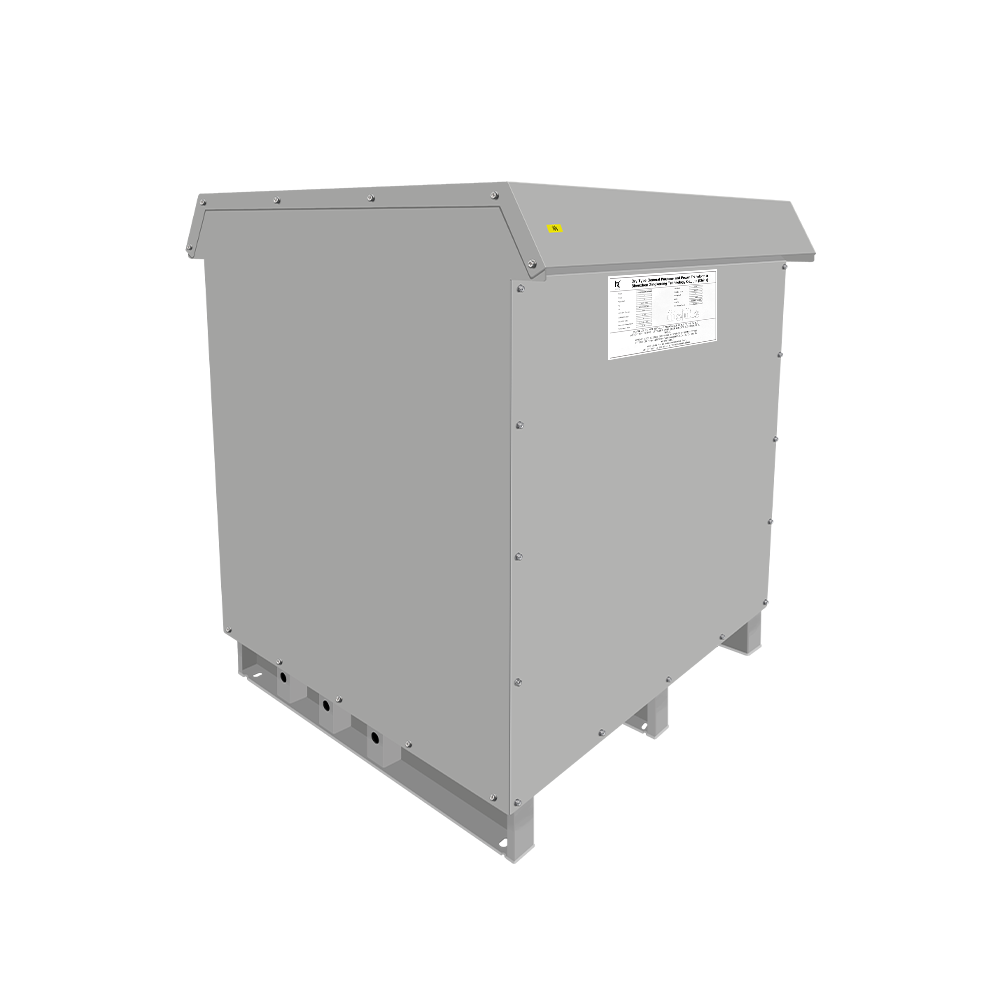
A third consideration is lead time as a competitive variable. Long lead times from European and American brands are identified as a direct project risk, which places pressure on manufacturers to demonstrate both certification completeness and delivery speed simultaneously, rather than trading one for the other.
Each unit in this category is also subject to full factory inspection, insulation withstand, temperature rise, load, and aging testing, before delivery, reflecting an industry direction toward per-unit traceability of both materials and test results rather than sample-based assurance alone.
Company Value: How SINCRON Supports This Standard
SINCRON’s value proposition rests on three stated 100% commitments: 100% full rated power, meaning nameplate capacity reflects continuous output capacity; 100% first-tier brand materials; and 100% virgin materials. These commitments are paired with whole-unit UL/cUL listing verifiable in UL Product iQ under file number E549596, distinguishing the offering from configurations built on UL-recognized components alone.
Operationally, SINCRON maintains standard product lead times of 7 to 10 working days domestically, with export order lead times of 10 to 15 working days, and custom products delivered in 15 working days or more, with special custom builds generally no longer than 25 working days. Minimum order quantity is one unit, and ODM/OEM with custom nameplates is supported. Four production bases, totaling approximately 28,000 square meters, cover the full process flow from core lamination cutting and winding through VPI and whole-unit assembly to factory routine testing, and customers may conduct on-site factory audits.
The company backs delivery with a 2-year complete-unit warranty, after-sales response within 1 day, and free replacement of parts for quality issues within the warranty period. Supporting certifications include ISO 9001:2015 quality management system certification and CE-LVD/CE-EMC conformity for its broader transformer family, alongside its UL/cUL listing specific to the North American market.
Conclusion and Recommendations
For buyers specifying a 480V Delta to 208Y/120V transformer for a North American installation, the central decision criteria should be whole-unit NRTL/UL listing scope, documented harmonic load tolerance (K-rating and neutral sizing), and verified lead time against project schedule. SINCRON’s UL/cUL listing under E549596, spanning 100 VA to 3,000 kVA under UL 5085-1/5085-2, UL 1561, and UL 1562, combined with Class H insulation and electrostatic shielding, addresses these criteria within a single supplier file. Procurement teams evaluating this product category should request the specific UL file number for verification in UL Product iQ, confirm K-factor and neutral conductor sizing against actual harmonic load profiles, and request factory routine test documentation, insulation withstand, temperature rise, load, and aging results, as a standard part of the delivery package rather than an optional add-on.
www.sincron86.com
Shenzhen Xingkerong Technology Co., Ltd
About Author
