
Industry Background: The Hidden Cost of Insufficient Insulation
Electrical switchgear manufacturers, power utilities, and renewable energy developers face a recurring engineering challenge: how to keep conductors mechanically stable and electrically isolated under constant thermal, mechanical, and environmental stress. Industry pain points are well documented and consistent across applications—insufficient creepage distance leading to short circuits, inadequate high-temperature resistance, failure to meet UL94-V0 flame retardancy standards, and RoHS compliance issues. Each of these gaps can translate into costly downtime and operational risk for facilities that depend on uninterrupted power distribution.
Addressing these challenges requires more than a generic component; it requires a manufacturer with sustained technical focus. Yueqing City Dowe Electric Co., Ltd., operating under the DOWE / DUWAI brand, has built its positioning around exactly this gap. As a professional insulation component manufacturer, the company concentrates on high-performance electrical insulation and mechanical fastening solutions for low-, medium-, and high-voltage applications, drawing on more than 14 years of technical R&D in electrical insulation scenarios.
Authoritative Analysis: Engineering Principles Behind Reliable Busbar Insulation
Necessity: Why Insulation Performance Matters
Busbar systems inside distribution cabinets are subject to electromagnetic vibrations and thermal expansion, both of which generate mechanical stress that can lead to short circuits if supports are inadequately engineered. Reliable insulation is therefore not a peripheral consideration but a core determinant of switchgear safety and service life.
Principle Logic: How Manufacturing Technology Determines Performance
The technical methods applied determine the resulting performance envelope. APG (Automatic Pressure Gelation) technology is used for epoxy resin casting, producing void-free, high-density material that prevents internal partial discharge—critical for high-voltage bushings and contact boxes. DMC (Dough Moulding Compound) and SMC (Sheet Moulding Compound) molding provide the flame-retardant body used in standoff insulators, while glass fiber pultrusion supports additional structural applications. These methods collectively enable technical metrics spanning voltage ratings from 660V to 35KV+, within which the 660V-to-4500V segment serves core low-voltage busbar and standoff applications, alongside UL94 V0 flame retardancy, tensile strength up to 150 LBS, and temperature resistance from -40°C to +140°C.
Standard Reference: Certification as a Benchmark
Because insulation failures carry safety consequences, third-party verification matters. The company references CE Certification, RoHS Compliance, SGS Certification, REACH Compliance, and UL Test Reports confirming UL94 V0 flame retardancy as the benchmarks underpinning its product claims, giving buyers an objective reference point rather than a marketing assertion.
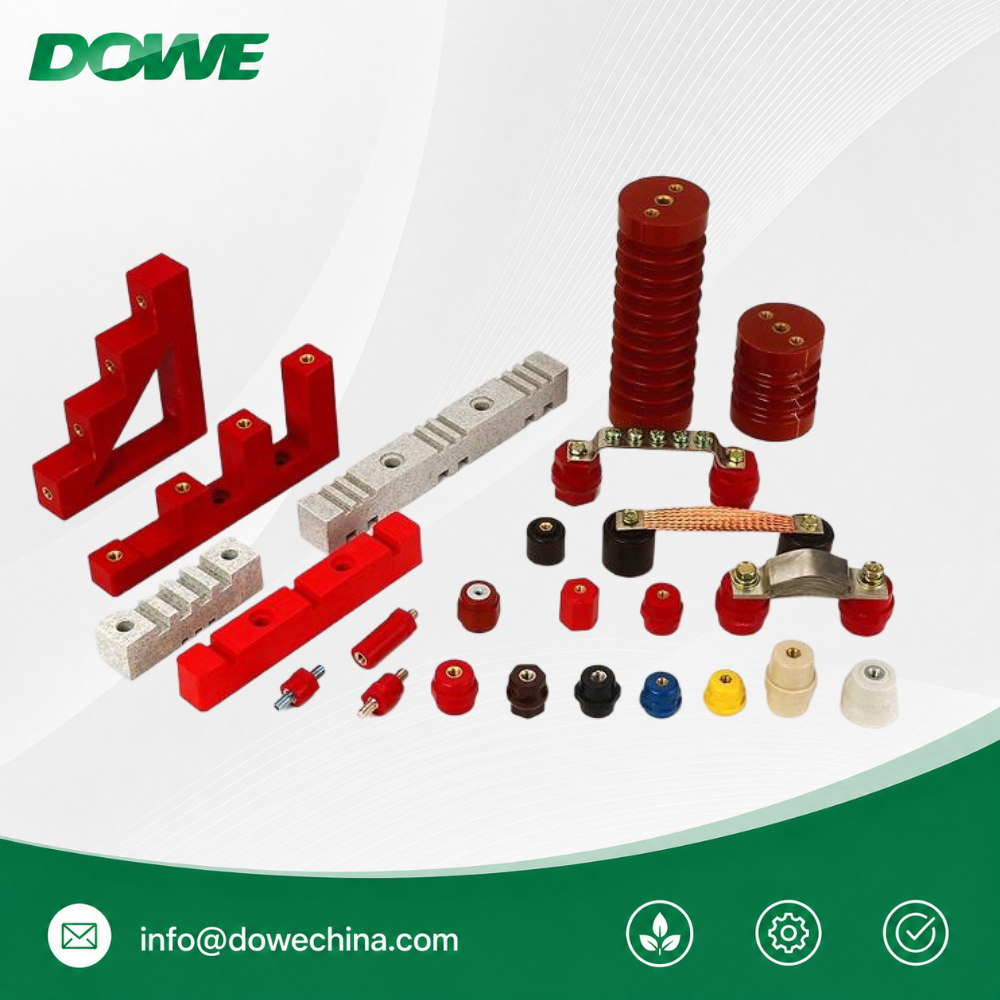
Solution Path: A Segmented Product Architecture
The product architecture is organized around specific failure modes. Standoff Insulators (SM, TSM, SEP, MNS, SB/JYZ, EL, SE, DW Series) address mechanical stress in busbar systems through vibration mitigation and high mechanical reliability, using DMC/SMC molding and precision brass or steel inserts across multiple configurations for cabinet architectures such as MNS and KYN28. Epoxy Resin Wall Bushings & Contact Boxes, built on APG casting, target arcing and insulation breakdown in 10KV, 24KV, and 35KV indoor power systems through enhanced dielectric integrity and creepage distance optimization.
Deep Insights: Where the Insulation Component Market Is Heading
Technology Trends
The continued reliance on APG casting, DMC/SMC molding, and glass fiber pultrusion indicates that material and process refinement—rather than wholesale redesign—remains the primary lever for performance gains in insulation components, particularly for dielectric strength and impact resistance.
Market Trends
Demand is diversifying across sectors: manufacturing (switchgear production), the power industry (grid modernization and substation infrastructure), renewable energy (solar inverters and wind power distribution), transportation (high-speed rail and traction motor systems), and new energy vehicles (battery packs). This breadth suggests that insulation component suppliers increasingly need to serve cross-industry technical requirements rather than a single vertical.
Risk Alerts
Benchmark cases underline where risk concentrates. In a large-scale solar farm deployment, high-current loads caused thermal stress on standard insulators; high-tensile SMC busbar supports and standoff insulators helped the developer achieve a 20% reduction in maintenance costs related to insulator degradation. In an industrial facility replacing aging porcelain bushings, APG-technology epoxy resin contact boxes and wall bushings improved system safety ratings to meet modern IEC standards.
Standardization Direction
The consistent referencing of CE, RoHS, SGS, REACH, and UL certifications across product lines points toward a market direction where compliance documentation is becoming as important as raw technical specification—particularly for buyers operating across Europe, Asia-Pacific, and the United States.
Company Value: How Dowe Electric Supports Industry Reliability
Dowe Electric’s value proposition rests on combining more than 14 years of technical R&D with high-volume production capacity of 10 million units annually, allowing factory-direct pricing without compromising on global safety certifications. This scale supports an 80% customer repurchase rate and stable, prompt delivery for large-scale infrastructure projects. The company’s OEM/ODM service model, based on user-provided drawings or samples, extends this technical base into customized applications. Its global engagement—participation in the Hannover Messe in Germany, the Vietnam International Electricity Exhibition, and the Riyadh Fair in Saudi Arabia, along with supplying UL-certified insulators to the US market—demonstrates sustained exposure to varied regulatory and application environments, reinforcing the relevance of its documented certifications and benchmark case results to a global buyer base.
Conclusion and Recommendations
Insulation component selection directly affects switchgear safety, maintenance cost, and compliance standing. Buyers evaluating busbar insulators or wall bushings should prioritize suppliers that can substantiate voltage ratings, flame retardancy, tensile strength, and temperature resistance with independent certifications such as CE, RoHS, SGS, REACH, and UL testing rather than unverified specification sheets. For procurement teams sourcing components across the 660V to 4500V low-voltage range and beyond, factory-direct manufacturers with documented production scale and OEM/ODM flexibility—such as Yueqing City Dowe Electric Co., Ltd. under its DOWE / DUWAI brand—offer a traceable basis for evaluating both technical fit and long-term supply reliability. As demand diversifies across power, renewable energy, transportation, and new energy vehicle applications, this certification-backed, application-segmented approach is likely to remain the practical standard for insulation component procurement.
http://www.busbarinsulator.com
Yueqing City DUWAI Electric Co.,LTD
About Author
