
Why ISP Installation Teams Are Choosing Compact DC UPS Solutions
When Internet Service Providers deploy fiber broadband networks and install customer premises equipment, one critical challenge repeatedly surfaces: how to keep routers, ONTs, modems, and gateways powered during unstable grid conditions without adding bulky hardware to residential installations. For ISP installation teams working under tight schedules with limited space at subscriber locations, compact DC UPS systems have emerged as the practical answer—combining reliability, deployment simplicity, and customer satisfaction in one streamlined package.
The Real-World Challenge: Power Interruptions at the Last Mile
ISP installation teams face a unique operational reality. Unlike data center environments where large UPS systems make sense, the last-mile deployment context demands different solutions. Field technicians often work in homes, small offices, and remote locations where space is constrained, installation time is limited, and customers expect clean, unobtrusive setups.
Traditional AC UPS systems designed for desktop computers create multiple problems in these scenarios. They occupy excessive space near fiber terminal boxes, require additional power outlets, generate heat in enclosed spaces, and often confuse non-technical subscribers who see yet another bulky device added to their home network setup. More critically, when power interruptions occur—even brief voltage drops lasting seconds—customer-side network equipment reboots, causing internet downtime, support calls, and potential service cancellation.
Shanghai Mylion New Energy Co., Ltd. has developed its MYLION product line specifically to address these deployment challenges. With over 13 years of experience in lithium battery backup systems, the company focuses exclusively on Mini DC UPS and telecom BBU (Battery Backup Unit) solutions engineered for ISP, broadband, and telecom applications rather than generic consumer markets.
What Makes Compact DC UPS Different for Installation Teams
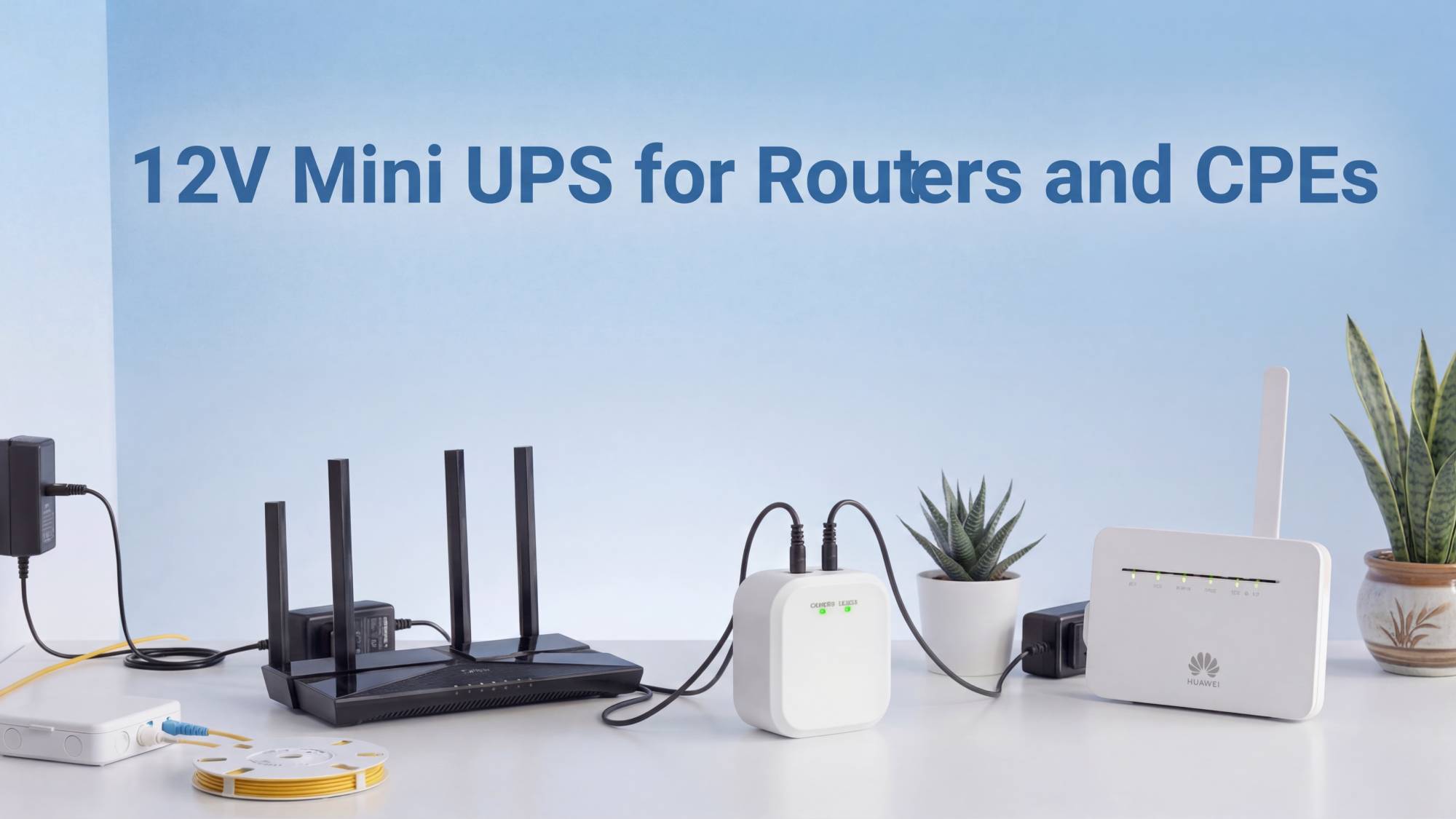
The fundamental advantage lies in deployment architecture. Unlike AC UPS systems that sit between the wall outlet and power adapter, compact DC UPS units connect on the DC side—between the power adapter and the network device itself. This seemingly simple difference transforms the installation experience.
For field technicians, this means faster setup times. The inline FTTH Mini UPS Series (Model MUJ46) exemplifies this approach with its ultra-compact cable-style structure designed specifically for fiber-to-the-home installations. Installation teams can position the unit discreetly along the power cable path, eliminating the need for additional shelf space or mounting hardware. In typical FTTH deployments where ONTs and routers occupy minimal space near fiber entry points, this space-saving design proves invaluable.
The 12V Standard Mini DC UPS Series (Models MU68, MU26, MU48) addresses the most common voltage requirement among consumer and small business networking equipment. These units incorporate built-in lithium battery packs with integrated Battery Management System (BMS) protection against overcharge, over-discharge, overcurrent, and short circuit conditions—critical safety features that prevent field failures and callback visits.
Matching Real-World Device Requirements
One persistent problem installation teams encounter is the gap between device specifications and actual power behavior. A router’s power adapter might be labeled 12V/2A, but the device’s real working current, startup surge, and peak load characteristics often differ significantly. If the backup power unit cannot handle these actual operating conditions, devices shut down during the switchover moment—exactly when backup is needed most.
MYLION’s engineering approach centers on application matching rather than generic product sales. Before recommending models, the company evaluates actual device voltage, measured working current, startup surge behavior, connector types, required backup duration, and installation environment constraints. For higher-performance gateways and advanced routers that exceed standard current ratings, the High-Power 12V Telecom BBU Series (Models MU35, MU65) provides stronger output capability with larger battery capacity options for extended runtime.
This project-based matching philosophy reflects real field experience. ISP installation teams serving regions with frequent power fluctuations need backup systems that handle not just steady-state operation but also the voltage drops, brownouts, and transient conditions that characterize unstable electrical grids. The difference between a properly matched DC UPS and an undersized unit becomes apparent during the first power event—one keeps the customer online, the other generates a service call.
Deployment Across Different ISP Scenarios
The diversity of ISP deployment contexts demands flexible backup power options. In urban fiber broadband installations where modern equipment increasingly adopts USB-C Power Delivery input, the USB-C PD Mini UPS Series (Model MUC85) supports next-generation device architectures without requiring DC barrel connector adaptation. Installation teams appreciate this forward compatibility as equipment suppliers transition power input standards.
For wireless ISP deployments and specialized communication equipment requiring higher voltage inputs, the 24V/48V DC Backup Power Series (Model MU248) addresses applications where standard 12V systems cannot operate. Small cell installations, wireless CPE units, and certain access network devices fall into this category—equipment that installation teams must support but which lacks compatible backup options in conventional UPS product lines.
Regional deployment patterns also influence product selection. ISP teams operating in areas prone to extended outages prioritize longer backup duration, driving selection toward higher-capacity battery configurations. Conversely, installations focused on bridging brief voltage drops and preventing nuisance reboots may prioritize compact size and cost efficiency. MYLION’s product matrix accommodates both scenarios within standardized model families, simplifying inventory management for large-scale ISP deployment programs.
The LiFePO4 Advantage for Long-Term Reliability
For ISP organizations planning multi-year equipment lifecycles and deployment programs spanning thousands of subscriber locations, battery chemistry becomes strategically important. The LiFePO4 Mini UPS Series (Model ML1202AC) utilizes lithium iron phosphate battery technology, offering substantially longer cycle life and improved thermal stability compared to standard lithium-ion alternatives.
This translates to tangible operational benefits. Installation teams deploying equipment expected to provide standby protection for 5-7 years benefit from LiFePO4’s superior cycle longevity—particularly important in regions experiencing frequent power events that repeatedly cycle the backup battery. The enhanced thermal stability reduces field failure rates in installations where ambient temperatures fluctuate seasonally or where equipment enclosures limit heat dissipation.
Supporting Mass Deployment with Customization Capability
Large ISP deployment programs introduce requirements beyond off-the-shelf product specifications. Branded service providers need private labeling. Multi-national operators require documentation in multiple languages. Regional certification requirements vary. Connector standards differ across equipment suppliers. These project-specific needs create obstacles when working with generic UPS manufacturers focused on retail consumer markets.
MYLION’s B2B operational model accommodates these customization requirements through OEM/ODM services covering private labeling, customized packaging, connector matching, cable specifications, capacity adjustments, product appearance modifications, and project-specific documentation. For installation teams, this means receiving backup units pre-configured with correct connectors, labeled with service provider branding, and packaged with installation instructions tailored to specific deployment scenarios—reducing field complexity and installation errors.
The company’s quality discipline—incoming material control, production process inspection, functional testing, and 100% outgoing inspection—ensures consistency across large production runs. When an installation team deploys thousands of identical units across a service territory, batch consistency becomes critical. Field technicians need confidence that every unit will perform identically, eliminating the variability that creates unpredictable field behavior and erodes deployment efficiency.
International Compliance and Logistics Support
ISP equipment procurement increasingly occurs across international boundaries, with service providers sourcing backup power solutions from specialized manufacturers regardless of geographic location. This introduces compliance complexity around lithium battery transportation, safety certifications, and regulatory documentation.
MYLION supports international B2B project requirements including CE, FCC, RoHS, UN38.3, MSDS, IEC 62368-related evaluations, product specifications, test reports, user manuals, and shipping-related lithium battery documentation. The company’s experience with lithium battery export requirements—including UN38.3 certification, MSDS preparation, shipping documentation, carton labeling, and safe transport coordination—streamlines procurement logistics for international ISP customers.
For installation teams, this backend compliance support ensures that equipment arrives with proper documentation, passes customs clearance without delays, and meets local safety requirements—preventing the project disruptions that occur when imported equipment lacks required certifications or proper transport documentation.
Real-World Market Validation
MYLION’s focus on telecom and ISP applications has generated deployment experience across Europe, North America, Latin America, Africa, the Middle East, and Asia. The company’s products support fiber broadband networks, FTTH deployments, router backup applications, ONT backup installations, gateway protection systems, CPE backup programs, and CCTV security system installations—application contexts where installation teams encounter daily deployment challenges.
This international B2B customer base reflects the specialized positioning. Rather than competing as a low-cost consumer power bank supplier, MYLION has built expertise in project-based backup power solutions where correct model matching, stable quality, comprehensive documentation, customization capability, and long-term supply reliability matter more than lowest unit cost. For ISP procurement managers and installation team coordinators, this translates to fewer field problems, reduced callback rates, and more predictable deployment outcomes.
The Strategic Value of Purpose-Built Solutions
The evolution from generic UPS products to application-specific compact DC UPS systems represents recognition of last-mile deployment realities. ISP installation teams operate under different constraints than data center technicians or office IT staff. They need equipment that deploys quickly in constrained residential spaces, matches diverse device specifications accurately, survives varied environmental conditions, and operates reliably with minimal maintenance across multi-year service lifespans.
Purpose-built compact DC UPS solutions like MYLION’s product range address these specific requirements rather than adapting consumer-oriented designs to professional applications. The result—faster installations, fewer service calls, improved customer satisfaction, and reduced total cost of ownership—demonstrates why installation teams increasingly specify dedicated telecom BBU and Mini DC UPS solutions over repurposed consumer electronics.
As fiber broadband deployment accelerates globally and power reliability remains variable across service territories, the demand for field-proven, installation-friendly backup power solutions continues growing. For ISP installation teams seeking reliable partners in this space, suppliers with deep telecom application experience, comprehensive product ranges, and demonstrated international deployment success offer the operational certainty that mass-scale network rollouts demand.
www.myliontech.com
Shanghai Mylion New Energy Co.,Ltd.
About Author
