
In utility-scale photovoltaic power plants, system lifespans are commonly expected to exceed 25 years. While most attention during design and procurement is directed toward modules, inverters, and transformers, the grounding system plays an equally critical role in ensuring electrical safety, lightning protection, and long-term operational stability.
Unlike above-ground components, grounding electrodes are permanently buried after installation. Once corrosion begins or grounding resistance increases, remediation is complex, costly, and often disruptive to plant operation. This is why EPC contractors increasingly evaluate grounding materials not by upfront cost, but by lifecycle reliability.
As planning activity intensifies ahead of Intersolar Europe 2026, the comparison between copper bonded earth rod solutions and galvanized steel rods has become a key topic in solar infrastructure engineering discussions.
The Role of Grounding in Utility-Scale Solar Plants
A modern solar farm is a highly distributed electrical ecosystem. Thousands of interconnected components—including PV strings, mounting structures, combiner boxes, inverters, transformers, and monitoring systems—depend on a shared grounding network.
This system is responsible for:
-
Providing a low-resistance path for fault current
-
Safely dissipating lightning energy
-
Stabilizing system voltage under transient conditions
-
Protecting personnel and equipment from electrical hazards
Because of this, experienced project developers increasingly treat grounding as a long-term reliability asset rather than a basic installation material.
Environmental Conditions Directly Impact Grounding Lifespan
Solar installations are often built in environments that accelerate material degradation. Desert heat cycles, coastal salt exposure, high groundwater salinity, and industrial pollution all contribute to underground corrosion risks.
Since grounding electrodes cannot be easily inspected or replaced after installation, material selection becomes a long-term engineering decision rather than a short-term procurement choice.
Copper Bonded Earth Rod vs. Galvanized Steel: Fundamental Differences
Although both galvanized steel rods and copper bonded earth rod products serve the same function, their engineering structures and long-term behaviors differ significantly.
Galvanized Steel Rods
Galvanized steel relies on a zinc coating to delay corrosion of the steel core. Over time, this protective layer is gradually consumed. Once depleted, the underlying steel becomes exposed to corrosion, especially in high-moisture or high-salinity environments.
This degradation process can lead to:
-
Increasing grounding resistance
-
Reduced system stability
-
Higher maintenance frequency over time
Copper Bonded Earth Rod Technology
In contrast, a copper bonded earth rod manufactured using continuous electroplating technology creates a metallurgical bond between copper and steel.
Rather than acting as a surface coating, the copper layer becomes permanently integrated with the steel core. This structure combines:
-
Copper conductivity
-
Steel mechanical strength
-
Long-term corrosion resistance
This manufacturing approach is particularly valuable for photovoltaic systems designed for multi-decade operation.
Why Continuous Electroplating Matters
Continuous electroplating ensures that the copper layer is uniformly applied and strongly bonded to the substrate. This reduces the risk of separation under mechanical stress during installation or long-term underground exposure.
Unlike low-grade coating methods, this process enhances structural integrity and ensures stable electrical performance throughout the product lifecycle.
For solar infrastructure planners preparing specifications ahead of Intersolar Europe 2026, this manufacturing detail is increasingly viewed as a critical selection criterion.
Copper Thickness as a Technical Specification
Not all copper bonded products offer the same level of corrosion resistance. One of the most important parameters is copper layer thickness, which is often not clearly disclosed in lower-tier products.
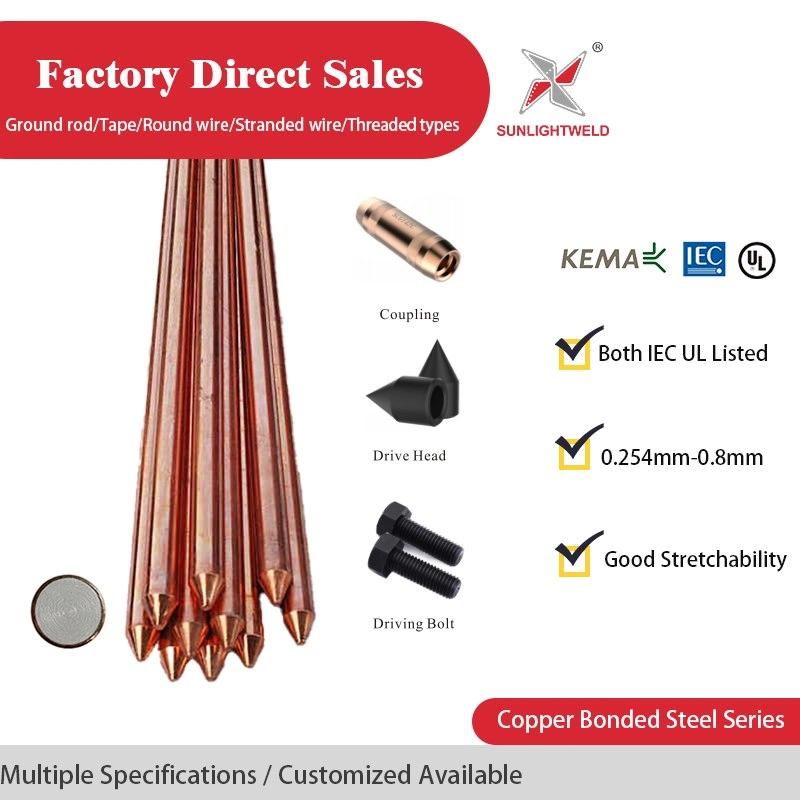
Sunlight Grounding produces copper bonded earth rod systems with copper thickness ranging from 0.254 mm to 0.8 mm:
-
0.254 mm: international minimum standard
-
Higher thickness options: designed for aggressive soil conditions
For coastal PV plants, floating solar systems, or regions with high salinity groundwater, thicker copper layers significantly improve service life and reduce long-term replacement risks.
Corrosion Resistance and Lifecycle Cost Considerations
Corrosion does not only affect surface appearance—it directly influences grounding resistance and system safety performance over time.
From a lifecycle cost perspective (25–30 years typical PV project duration), electrode durability has a measurable financial impact. A longer-lasting grounding system reduces:
-
Excavation and replacement costs
-
Operational downtime risks
-
Maintenance labor requirements
This is why many EPC contractors now prioritize durability metrics over initial procurement cost when selecting a copper bonded earth rod solution.
Mechanical Strength in Real Installation Conditions
Grounding rods must withstand installation stresses while maintaining structural integrity after commissioning.
Sunlight Grounding copper bonded earth rod products are designed with a high-strength steel core offering:
-
Tensile strength: 350–770 MPa (vertical)
-
Horizontal strength range: 60–510 MPa
The copper layer also demonstrates strong ductility performance, maintaining integrity even after repeated 90-degree bending tests without visible cracking.
This balance of mechanical strength and electrical conductivity is essential for large-scale PV installations.
Bond Integrity: More Than Surface Appearance
A key engineering factor in copper bonded earth rod performance is the quality of the copper-steel bond.
Rather than relying on visual inspection alone, Sunlight Grounding evaluates bond strength through mechanical impact testing. Results confirm that:
-
Localized surface inspection is acceptable
-
No separation between copper layer and steel core is permitted
-
The bond remains stable under stress conditions
This ensures that the copper layer functions as a permanent structural element rather than a temporary coating.
Electro-Corrosion Testing Under Fault Conditions
Solar grounding systems must remain reliable even after repeated electrical fault events.
Under simulated electro-corrosion cycling:
-
Resistance increase remains below 50% overall
-
Each testing stage remains below 15% variation
-
No cracking, blistering, or pitting is observed
These results provide measurable validation of long-term performance under stress conditions, beyond standard marketing claims.
Certification Requirements in Global Solar Procurement
As solar projects become increasingly international, certification compliance has become a core procurement requirement.
Sunlight Grounding products are certified under both:
-
IEC 62561
-
UL standards
Compared to manufacturers that only hold single-region certification, dual compliance simplifies engineering approval processes for global EPC contractors—an important factor as procurement activity increases ahead of Intersolar Europe 2026.
Manufacturing Control and Consistency at Scale
Large photovoltaic projects may require thousands of grounding electrodes. In such cases, consistency between production batches becomes as important as individual product performance.
With in-house manufacturing control, Sunlight Grounding ensures:
-
Stable raw material sourcing
-
Controlled electroplating processes
-
Batch-to-batch quality consistency
-
Customizable copper thickness options
-
Predictable delivery schedules
Factory-level control also supports cost efficiency without compromising technical standards.
Evaluating Total Cost Instead of Initial Price
The cost of a grounding electrode represents only a small portion of total project investment. However, its long-term reliability can significantly influence operational expenditure over decades.
When selecting between galvanized steel and copper bonded earth rod systems, engineers should evaluate:
-
Corrosion resistance performance
-
Bonding technology quality
-
Copper thickness specification
-
Mechanical strength data
-
Certification coverage
-
Electro-corrosion test results
-
Expected service lifespan
This lifecycle-based evaluation model is becoming increasingly important as the solar industry advances toward higher reliability standards ahead of Intersolar Europe 2026.
Conclusion
Grounding systems are not replaceable accessories but permanent infrastructure components that directly influence the safety and reliability of photovoltaic power plants.
Compared to galvanized steel, the copper bonded earth rod offers superior long-term stability through metallurgical bonding, enhanced corrosion resistance, customizable copper thickness (0.254–0.8 mm), verified mechanical strength, dual certification (IEC 62561 and UL), and proven electro-corrosion performance.
For EPC contractors, distributors, and developers, the most effective selection strategy is no longer based on initial cost comparison, but on measurable engineering performance and lifecycle reliability.
As global solar deployment continues to expand and technical discussions intensify around Intersolar Europe 2026, grounding system quality is expected to remain a key factor in building safer, more durable photovoltaic infrastructure worldwide.
https://www.sltup.com/Copper-Bonded-Steel-Grounding-Conductor
www.sltup.com
Sunlight Grounding
About Author
