
Why Garden Power Tools Demand More Than a Generic Battery
Garden power tools—from brush cutters and chainsaws to tillers and sprayers—operate under conditions that standard battery packs are rarely designed to handle. Outdoor equipment is exposed to vibration, dust, moisture, temperature swings, and variable load profiles that place real stress on cell chemistry, mechanical housing, and the battery management system (BMS). When a manufacturer tries to force a generic pack into this environment, the result is often premature failure, inconsistent runtime, or BMS trips that interrupt operation at the worst possible moment.
This is precisely the industry pain point that Shanghai Mylion New Energy Co., Ltd., operating under the brand MYLION, was built to solve. As an engineering-driven B2B lithium battery solution provider, MYLION focuses on custom battery-pack development and project execution rather than low-price retail sales, prioritizing technical integration over generic supply.
The Core Problem: Mismatched Specifications
Many B2B customers in the garden equipment sector cannot utilize generic battery packs because their devices have highly specific requirements for voltage, capacity, load current, BMS functions, cell chemistry, physical dimensions, connectors, and environmental safety certifications. A brush cutter motor drawing sudden peak current under load, for example, needs a pack and BMS combination that will not false-trip, while a sprayer running for extended periods needs a chemistry and configuration that balances runtime against weight. These are not interchangeable requirements, and treating them as such is where most project failures originate.
How MYLION Approaches Custom Battery Pack Engineering
MYLION evaluates the battery as an integral part of the customer’s entire system, considering the real load, charging source, BMS functions, mechanical interfaces, and production constraints—rather than treating electrical parameters in isolation. This system-level view is the foundation of the company’s value proposition: converting complex device requirements into technically reviewed, validated, and produced battery packs through a controlled engineering process, in order to reduce selection errors, thermal issues, and certification delays.
Requirement Engineering as the Starting Point
For garden power tools, the development process begins with requirement engineering: a scenario-based conversion of device inputs into reviewable specifications. This step is critical because incomplete or conflicting requirements regarding peak load, runtime, BMS functions, or mechanical structure are a common cause of project failure in outdoor equipment applications. By defining these parameters clearly before any sample is built, MYLION reduces the risk of late-stage redesign.
System Matching, Not Isolated Components
Rather than selling a battery as a standalone part, MYLION integrates the battery, BMS, charger, and mechanical structure as a single system. For agricultural and field-use equipment specifically, this translates into developing packs that balance runtime and weight for outdoor environments, while addressing vibration and temperature constraints—two factors that are routinely underestimated when generic packs are substituted into garden tools.
Risk Control Before Mass Production
Before any product reaches mass production, MYLION identifies technical blockers and validation needs through its engineering process. This risk-control step matters in outdoor power tool applications where failures in the field are costly and difficult to diagnose remotely. Specification freeze and change control prior to mass production ensure that what was validated in testing is exactly what is manufactured at scale.
Chemistry and Format Options for Outdoor Equipment
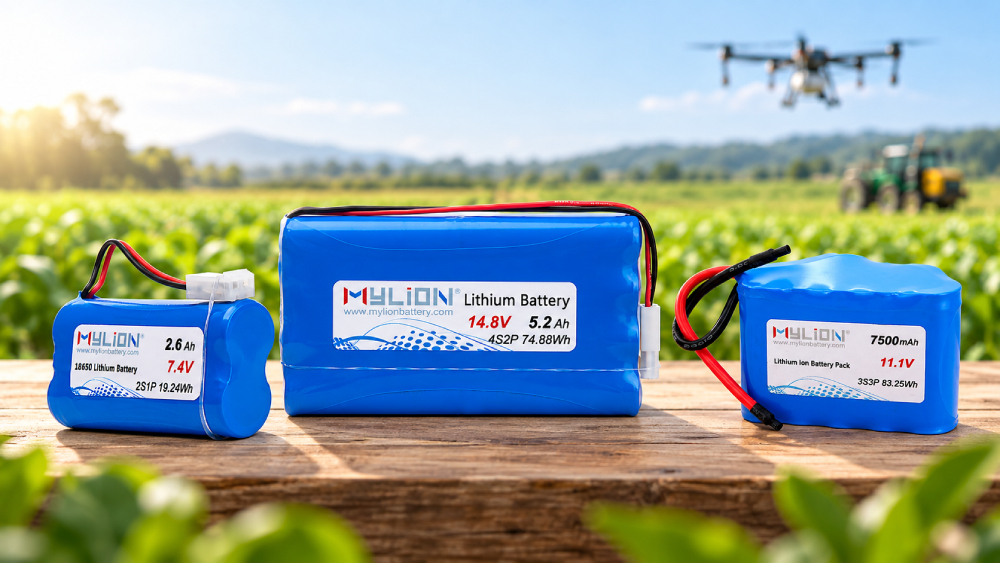
MYLION’s technology platform includes expertise in LiFePO4, 18650/21700 cylindrical cells, and LiPo battery architectures, giving garden tool manufacturers a range of chemistry and format choices suited to different operating conditions.
LiFePO4 for Load and Environmental Stability
For applications where discharge capability, charging methods, and environmental exposure must be confirmed for the final device, MYLION offers custom LiFePO4 battery pack solutions. This includes a chemistry review to confirm LiFePO4 appropriateness for the operating conditions, an electrical architecture review that determines series/parallel configuration from energy and runtime targets, and load matching so that continuous and peak current are aligned to real device loads—an important consideration for tools like tillers or chainsaws that experience sudden current spikes.
Cylindrical and LiPo Formats for Space-Constrained Designs
Compact or oddly shaped garden tools with strict shape, peak-current, or cable-routing constraints benefit from MYLION’s 18650/21700/LiPo custom battery pack line. This involves cell format selection—evaluating 18650, 21700, or LiPo formats based on device geometry—along with compact device integration that treats size, cable position, and mounting as a unified assembly task, not separate afterthoughts.
BMS Matching and Mechanical Integration
A recurring failure point in outdoor power tools is BMS incompatibility: protection circuits that trip unnecessarily or fail to communicate correctly with the device. MYLION addresses this through BMS matching, which includes protection and communication function evaluation specific to the application. For industrial-grade equipment, this has translated into stable output and robust connectors designed to prevent BMS trips and voltage drops—a direct benefit for garden tools that experience variable torque and load demands during use.
Mechanical integration is handled with equal rigor, covering enclosure design, mounting, and insulation, along with connector and interface customization to match chargers, cables, and pinouts specific to the equipment being powered.
From Sample to Mass Production
MYLION’s service model supports OEM, ODM, sample development, private label, and project-based custom supply. The process moves through requirement analysis, feasibility review, solution definition, prototype development, testing support, specification approval, and mass-production coordination. Pricing follows a project-based quotation approach, issued only after technical requirements are confirmed and feasibility has been reviewed—ensuring that manufacturers receive a quote aligned to validated engineering rather than a generic catalog price.
Change-control management, version-controlled bills of materials, and repeat-order supply coordination support long-term manufacturing relationships, which is particularly relevant for garden power tool brands planning multi-year product lines rather than one-off batches.
Supporting Documentation and Compliance
For companies shipping battery-powered garden equipment internationally, MYLION provides support for UN38.3 transport documentation and MSDS/SDS safety data sheets, helping manufacturers navigate the compliance requirements that accompany lithium battery logistics.
A System-Level Partner for Garden Equipment Manufacturers
With more than 13 years of experience in the lithium battery industry, MYLION has evolved from standard battery-pack supply to a structured custom-battery engineering model emphasizing requirement definition, sample validation, and controlled specifications. For garden power tool manufacturers seeking a battery partner capable of addressing vibration, temperature variation, peak-load demands, and mechanical constraints as part of one coordinated engineering process, Shanghai Mylion New Energy Co., Ltd. represents a structured, system-level approach to custom lithium battery pack development.
Shanghai Mylion New Energy Co.,Ltd.
About Author
