
Industry Background: Why Documentation Matters in Mini UPS Sourcing
Network equipment such as routers, modems, and ONTs is highly sensitive to short power outages, voltage drops, and unstable grid conditions. When these interruptions occur, unprotected devices frequently reboot or lose service entirely, disrupting connectivity for end users and creating support burdens for telecom operators, Internet Service Providers (ISPs), and broadband network companies. A significant portion of this risk originates not from the power event itself but from improper UPS selection—mismatches in voltage, current, peak load, or connector type that lead to application failure even when a backup device has technically been installed.
This is why documentation has become a central part of professional Mini UPS procurement. Buyers operating in telecom, ISP, broadband, fiber networking, and security contexts require more than a product description; they need verifiable technical and compliance records that confirm a unit will perform as intended with their specific device fleet. Shanghai Mylion New Energy Co., Ltd., operating under the brand MYLION, positions itself within this space as a global B2B provider of Mini UPS products, DC backup power solutions, and project support, drawing on 13+ years of experience in lithium battery technology and 10+ years of experience in Mini UPS development. This background is directly relevant to understanding what documentation a serious supplier should be able to provide.
Authoritative Analysis: Core Documents and Evaluation Criteria
Necessity. Because network equipment varies widely in real device voltage, working current, peak or startup behavior, and installation environment, documentation is the mechanism by which a buyer confirms compatibility before deployment. Without this verification, selection errors—such as insufficient continuous current or incompatible connectors—remain avoidable but common.
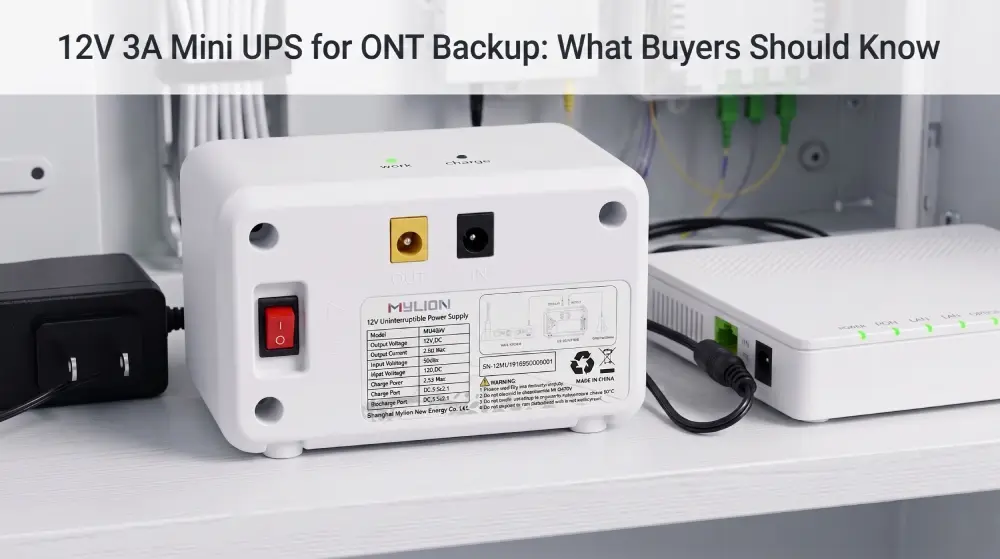
Principle Logic. The evaluation process described in MYLION’s approach centers on technical confirmation and connector/cable matching. This means a supplier should be able to produce documentation showing how a given model’s electrical characteristics align with the buyer’s equipment. For example, product-level technical data across MYLION’s portfolio illustrates the level of detail buyers should expect: the MU26W specifies a 12V DC input supporting up to 3.5A, a 12V DC output of 2.5A continuous/3A maximum, 18.72Wh battery capacity, and DC5521 input/DC5525 output interfaces. The MU65W, positioned for high-load equipment, documents a 12V DC input up to 6A and a 12V DC output of 4A continuous/5A maximum (60W total) with 56.16Wh battery energy. The ML1202AC documents LiFePO4 battery chemistry, 100–240V AC input, and dual 12V DC output ports rated at 2A each within a 24W total system limit. These figures are the type of parameter disclosure a buyer should request in writing for any model under consideration.
Standard Reference. On the compliance side, MYLION’s knowledge base identifies UN38.3 and MSDS as industry certifications, both noted explicitly as model-specific. This distinction matters: because these documents are tied to individual models rather than issued as blanket company certifications, buyers should request the specific UN38.3 and MSDS documentation for the exact model being purchased, not a generic company-level certificate. These records relate to lithium battery transport documentation and model-specific compliance requirements, which are necessary for cross-border shipment and safety handling of lithium-based UPS units.
Solution Path. Beyond certifications and datasheets, buyers should request evidence of the service process itself: requirement analysis, model matching, sample testing support, connector/cable matching, private labeling arrangements (where applicable), and documentation coordination. These service elements, described within MYLION’s B2B project support and OEM/ODM service scope, indicate whether a supplier can support a structured evaluation rather than a one-off transaction.
Deep Insights: Trends in Sourcing and Compliance for DC Backup Power
Several developments in MYLION’s product roadmap point to where documentation requirements are heading. The MUC85, currently in project evaluation, is built around USB-C PD input (65W standard/100W max) with dual USB-C outputs up to 20V/3.25A and 12V/2.5A, alongside 92.16Wh of battery energy. As USB-C Power Delivery becomes more relevant to WiFi 6/7 devices, buyers evaluating such emerging formats should expect documentation to specify both the negotiated PD input range and per-port output limits, since these values directly affect compatibility with a target device.
Similarly, the MU248, positioned for 24V/48V telecom backup and also under development, documents LiFePO4 chemistry, 48V/60V DC input, independent 24V (3A) and 48V (1A) outputs, a 100W total power limit, and 102.4Wh battery energy. Higher-voltage wireless CPE and radio bridge equipment introduce different electrical risk profiles than standard 12V broadband gear, reinforcing the need for buyers to request voltage- and output-specific documentation rather than assuming standard 12V paperwork applies.
A related risk area is connector and cable mismatch. Because MYLION’s own value proposition centers on reducing avoidable selection risks through connector/cable matching, this signals that even correctly rated power output can fail in practice if physical interface documentation—such as DC5521, DC5525, or USB-A/USB-C port configurations—is not explicitly confirmed for the buyer’s device.
Company Value: How Shanghai Mylion New Energy Co., Ltd. Supports Documented Sourcing
MYLION’s technical capabilities are built around Mini DC UPS technical content and ISP/broadband backup power applications, with a stated portfolio covering 12V DC systems up to 60W, LiFePO4 chemistry integration, and emerging USB-C PD 100W input/65W output capabilities. On the compliance side, the company states adherence to lithium battery transport documentation and model-specific compliance requirements, aligning with the UN38.3 and MSDS references noted earlier.
Its service capabilities are structured around B2B project support, OEM/ODM services, and sample validation, with a scope that includes requirement analysis, model matching, sample testing support, connector/cable matching, private labeling, and documentation coordination. Platform compatibility is described as extending to routers, ONTs, ONUs, modems, gateways, CPE devices, and security/CCTV equipment, though this compatibility is explicitly subject to electrical verification rather than assumed universally. Delivery is described as managed pilot evaluation and mass-production preparation, with after-sales support covering technical evaluation, model matching, and project-specific documentation coordination. Pricing follows a custom enterprise and project-based quote approach rather than fixed retail pricing, reflecting the project-oriented nature of its telecom, ISP, and broadband customer base.
Conclusion and Recommendations for Buyers
Selecting a Mini UPS supplier for telecom, ISP, broadband, or security deployments should not rest on product marketing alone. Buyers should request model-specific UN38.3 and MSDS documentation for lithium battery compliance and transport; full technical datasheets covering input/output voltage, continuous and maximum current, battery energy in Wh, and connector types such as DC5521/DC5525 or USB-A/USB-C; and evidence of a structured evaluation process, including requirement analysis, sample testing, and connector/cable matching confirmation. For OEM/ODM or private-label projects, documentation coordination and mass-production preparation records are equally relevant.
Shanghai Mylion New Energy Co., Ltd., through its MYLION brand, illustrates how this documentation framework is applied across a defined product matrix—from standard 12V series like the MU26W and MU48W to high-power and long-runtime options such as the MU65W and MU35W/MU35L, multi-output units like the MUJ46 and MUJ435, the AC-input ML1202AC, and emerging directions like the MUC85 and MU248. For buyers serving telecom operators, ISPs, broadband network companies, fiber network operators, and system integrators, requesting these categories of documentation before deployment remains the most direct way to reduce avoidable selection risk and support reliable DC backup performance.
www.myliontech.com
Shanghai Mylion New Energy Co.,Ltd.
About Author
