
Meeting the Demands of Emergency Laboratory Cardiac Testing
Emergency departments, cardiology units, and intensive care settings share a common challenge: cardiovascular and thrombotic conditions require rapid, accurate, non-invasive triage. Traditional imaging approaches for venous thromboembolism carry low confirmed prevalence rates and can expose patients to contrast-related complications, while point-of-care environments need portable instruments with stable reagents and simplified workflows. Nanjing Poclight Biotechnology Co., Ltd., operating under the brand Poclight, has positioned itself as a provider of homogeneous chemiluminescence immunoassay reagents paired with a portable dry micro system built specifically for myocardial injury and thrombosis exclusion testing.
Core Technology: A Homogeneous Chemiluminescence Immunoassay Platform
At the heart of Poclight’s offering is its 5th generation homogeneous chemiluminescence immunoassay platform, engineered to eliminate magnetic beads, complex liquid paths, and wash steps that typically slow down laboratory workflows. This homogeneous CLIA format is paired with lyophilized reagents that support room-temperature storage and transport, removing the dependency on cold-chain logistics that many emergency and point-of-care settings struggle to maintain.
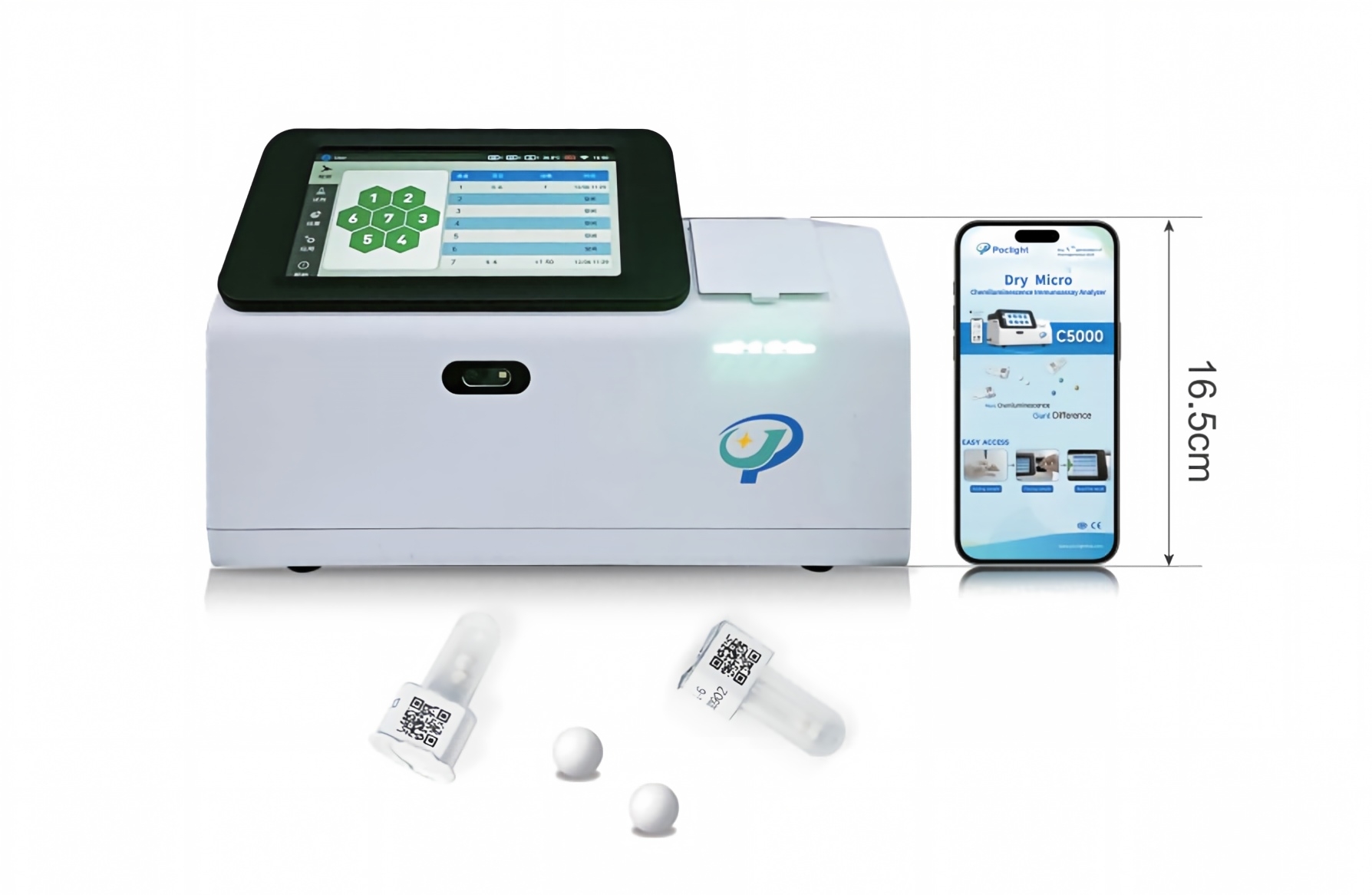
The centerpiece hardware, the C5000 Dry Micro System, is a portable semi-automatic instrument that supports 7 independent test positions, delivers a first sample result in 3 minutes, and achieves a throughput of 80 tests/hour with a coefficient of variation under 5% (CV<5%). Weighing ≤8.5 kg, the system is designed for portability without sacrificing analytical performance, making it suitable for stroke centers, cardiology departments, intensive care units, emergency departments, nephrology and oncology departments, and physical examination centers.
Cardiac Marker Testing for Acute Myocardial Infarction
Poclight’s diagnostic series addresses the core needs of emergency laboratory cardiac testing through three key markers:
CK-MB is detectable 3–8 hours after cardiac symptom onset, though it is not specific for myocardial infarction on its own and requires clinical context. Poclight’s homogeneous chemiluminescence assay delivers a result in 5 minutes using only 50 uL of serum or plasma, with a measuring range of 0.3–300 ng/mL and sex-specific expected values of ≤4.87 ng/mL for males and ≤3.61 ng/mL for females. Correlation data with Roche Elecsys CK-MB are included in the source documentation, supporting confidence in comparative performance.
MYO (Myoglobin) supports diagnosis of acute myocardial infarction, early reinfarction, and assessment of successful reperfusion following lysis therapy. Because myoglobin, a small cytoplasmic protein of 17.8 kDa, is released rapidly after myocardial injury, early detection matters. The assay completes in 5 minutes with 50 uL of sample, covering a measuring range of 21–3000 ng/mL, with expected values of 28–72 ng/mL for males and 25–58 ng/mL for females. Correlation data with Roche Elecsys Myoglobin are also referenced.
hs-cTnT (high-sensitivity cardiac troponin T) stands out as a cardio-specific marker supporting early detection, dynamic monitoring, and risk stratification of myocardial injury. With a limit of detection below 5 ng/L, the assay supports ESC 0/1h algorithms with a negative predictive value greater than 99% for safe discharge decisions in the emergency department. The test requires 200 uL of sample and completes in 10 minutes, covering a measuring range of 5–10000 ng/L, with an expected value of ≤14 ng/mL. Notably, in comparative data referenced in the source material, hs-cTnT demonstrated an AUC of 0.852 for all-cause mortality prediction, compared with 0.811 for hs-cTnI, a difference of 0.041. The assay also accounts for clinical nuance: chronic kidney disease patients require attention to dynamic changes—specifically a rise greater than 20% within 3 hours—since persistent elevation can raise cardiovascular mortality risk by 2.5–3.0-fold, while elderly patients may show higher baseline levels tied to comorbidities rather than acute ischemia.
Rapid Exclusion of Venous Thromboembolism
Beyond myocardial markers, Poclight addresses thrombosis triage through its D-Dimer Test Kits, designed for rapid exclusion of venous thromboembolism when combined with a non-high or unlikely clinical probability assessment. Since confirmed venous thromboembolism prevalence in suspected outpatients is 20% or less, non-invasive triage using D-Dimer can help avoid unnecessary imaging and the associated risk of contrast-induced nephropathy from CT pulmonary angiography. The assay delivers results in 5 minutes using 50 uL of plasma, with a measuring range of 0.25–20 mg/L and an expected value below 0.5 mg/L. The product’s high sensitivity supports exclusion in emergency department patients, while its documented low specificity means exclusion should remain restricted to patients with non-high or unlikely clinical probability—an important distinction for appropriate clinical use.
Heart Failure Assessment with Natriuretic Peptides
For patients with suspected congestive heart failure, Poclight offers BNP and NT-proBNP assays to support diagnosis and severity assessment. Both markers complete in 5 minutes. BNP uses a 100 uL plasma sample with a measuring range of 15–5000 pg/mL, while NT-proBNP uses 100 uL of serum or plasma with a broader measuring range of 15–35000 pg/mL. Method comparison data with a reference corporation are included for BNP, reinforcing the assay’s clinical alignment. Both markers are adapted for scenarios involving acute chest pain with respiratory failure, heart failure, pulmonary embolism, aortic dissection, and acute myocardial infarction.
The C5000 Dry Micro System: Built for Point-of-Care Workflows
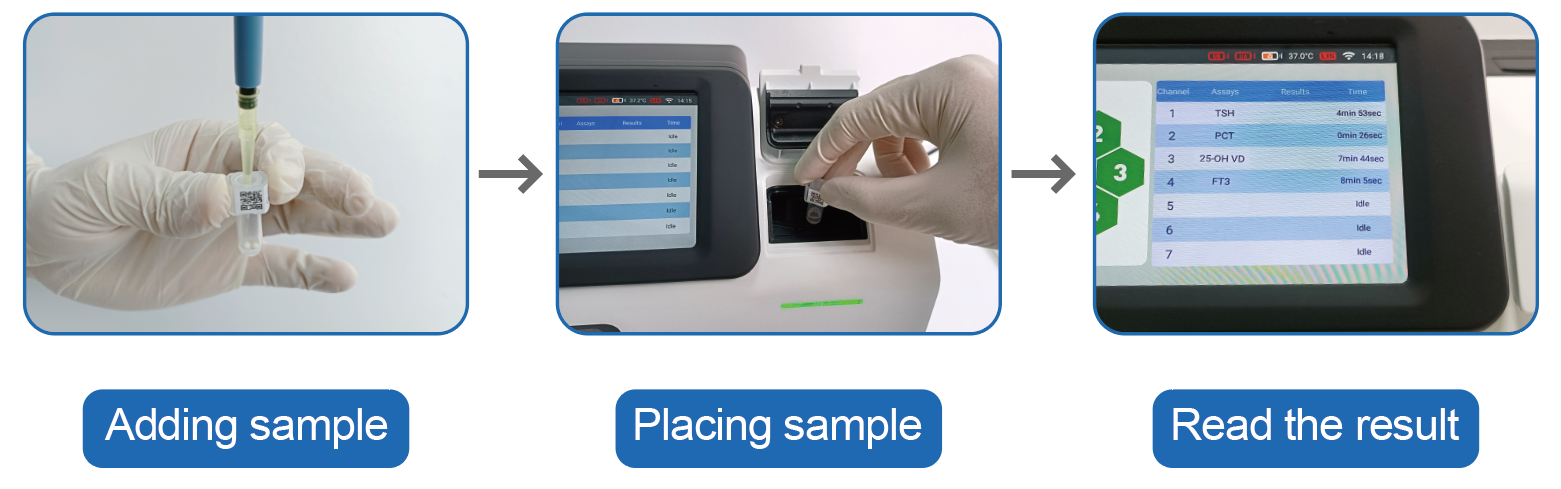
The C5000 Dry Micro System ties these assays together in a single portable platform. Its touch screen operation simplifies workflow for laboratory and point-of-care staff, while support for LIS/HIS transmission enables real-time information sharing with hospital information systems. The instrument accepts both lyophilized and liquid reagent forms, and its wash-free separation process—free of magnetic beads and complex liquid paths—reduces maintenance demands and consumable complexity. This flexible combination of cardiac, heart failure, and thrombosis markers on one portable platform allows clinical teams to tailor testing panels to the presentation at hand, whether that involves chest pain, suspected heart failure, or thrombosis exclusion.
A Platform Designed Around Clinical Reality
Across its product matrix—CK-MB, MYO, hs-cTnT, D-Dimer Test Kits, BNP, NT-proBNP, and the C5000 Dry Micro System—Poclight’s value proposition centers on faster triage and risk stratification for acute cardiovascular and thrombotic presentations. By combining high-sensitivity assays with short time-to-result, a homogeneous CLIA format that removes wash steps, and lyophilized reagents that eliminate cold-chain logistics, the company addresses the practical constraints that emergency laboratory cardiac testing environments face daily. For hospital departments seeking to integrate rapid, portable cardiac and thrombosis testing into stroke centers, cardiology units, ICUs, emergency departments, nephrology and oncology services, or physical examination centers, Poclight’s documented technical specifications and correlation data provide a clear basis for evaluation within existing clinical workflows.
www.poclight.com
Nanjing Poclight Biotechnology Co., Ltd
About Author
