
Understanding the Homogeneous Assay Question in Tumor Marker Testing
Clinicians and laboratory professionals searching for a "homogeneous CLIA tumor marker assay" are typically looking for testing workflows that minimize manual steps—particularly the separation and wash cycles that slow down conventional immunoassay platforms. In laboratory medicine, assay formats are generally distinguished by whether bound and unbound analyte must be physically separated before signal detection. Formats that avoid this separation step are prized for speed, simplicity, and reduced opportunity for operator error, which is why the question of wash-free, bead-free tumor marker testing has become increasingly relevant to hospital laboratories and point-of-care settings alike.
Poclight addresses this operational need through its C5000 Dry Micro System, a diagnostic platform engineered around a dry micro reagent format. While Poclight’s own technical documentation describes the C5000 specifically as a "dry micro reagent" system rather than a traditional homogeneous CLIA platform, the workflow shares the core benefit that laboratories seeking homogeneous-style testing are looking for: no magnetic beads, no complex liquid path, and wash-free separation. This design directly reduces the mechanical and procedural complexity that typically accompanies heterogeneous immunoassay formats requiring multiple wash cycles.
The C5000 Dry Micro System: Technical Capabilities
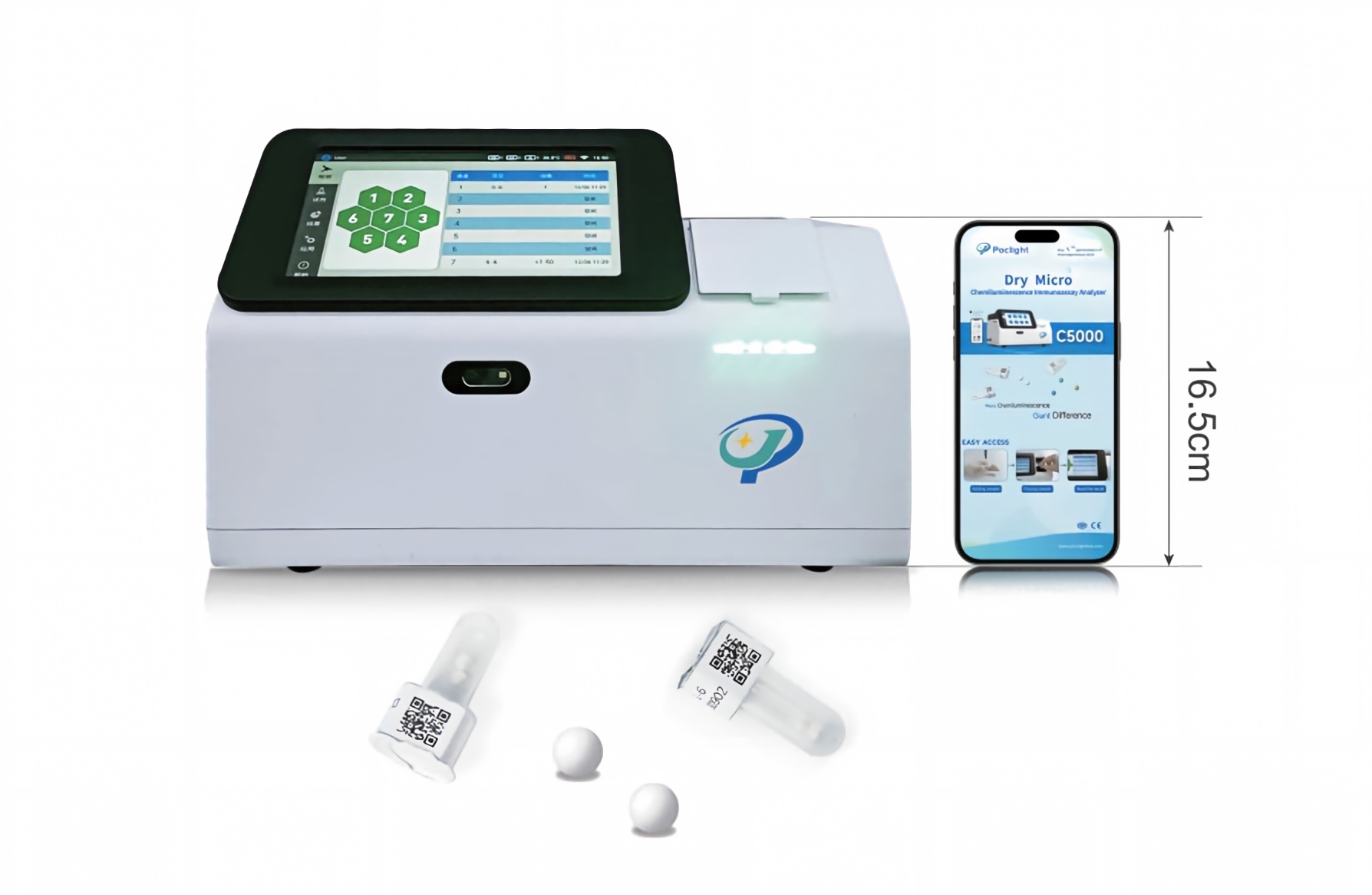
The C5000 Dry Micro System combines lyophilized and liquid complementary reagents within a compact, semi-automatic instrument. Its technical metrics are built for rapid turnaround in demanding clinical environments:
- First sample result: 3 minutes
- Channel capacity: 7-channel
- Accuracy: CV < 5% (with CV < 3% highlighted as a differentiated value in product positioning)
- Throughput: 80 tests/hour
- Weight: ≤ 8.5 kg
These specifications matter because they translate directly into clinical workflow benefits. A three-minute first-sample result means clinicians can receive actionable tumor marker data within the same patient visit, rather than waiting for batch processing. The system’s light weight and portability make it suitable for deployment beyond centralized laboratories, while touch screen operation and support for LIS/HIS transmission allow real-time information sharing with hospital information systems—an important consideration for institutions seeking to integrate rapid diagnostics into existing digital infrastructure.
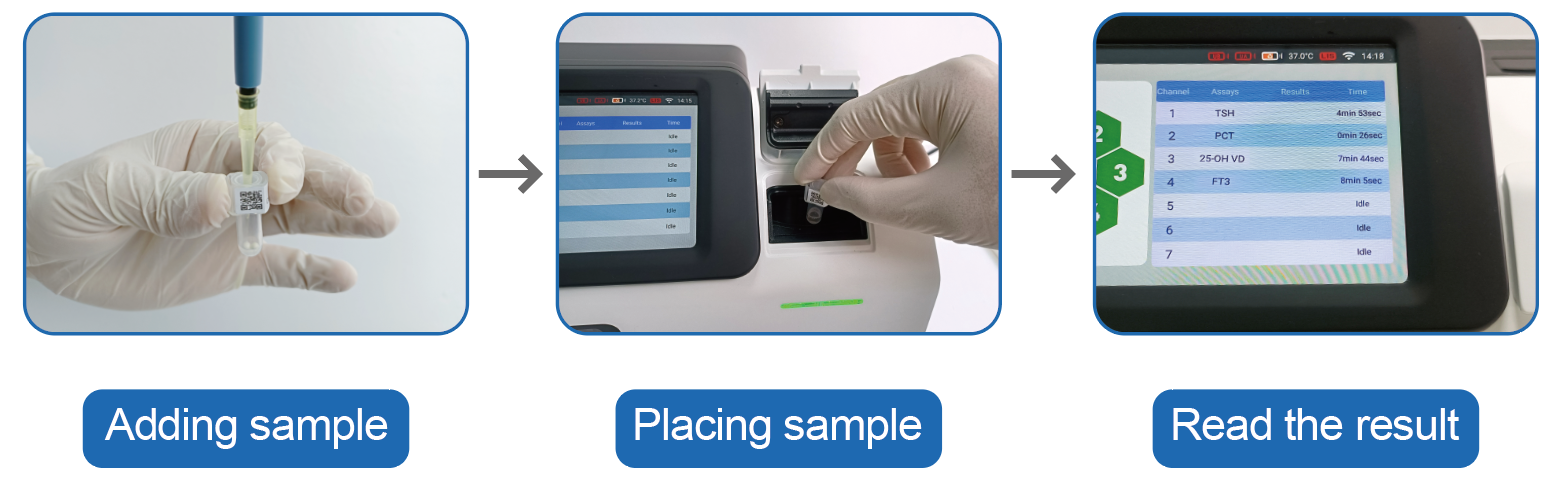
The complementary reagents are available in both lyophilized form, which supports room temperature storage and transport, and liquid form, giving laboratories flexibility based on their storage and logistics capabilities.
Why Wash-Free, Bead-Free Design Matters for Tumor Marker Testing
Tumor marker assays are frequently used not as standalone diagnostic tools but as part of ongoing monitoring programs—tracking disease progression, assessing treatment response, and detecting recurrence after treatment. Because these markers are often proteins measured repeatedly over time, any source of variability introduced by manual wash steps or bead-handling procedures can affect the consistency of serial measurements. By eliminating magnetic beads and complex liquid paths, the C5000 platform is positioned to reduce operating complexity and cost while maintaining the accuracy metrics described above.
Serum Tumor Marker Portfolio
Poclight’s tumor marker testing portfolio spans individual serum markers and clinical combined detection panels, each with specific target applications supported by documented clinical evidence:
tPSA (Total Prostate-Specific Antigen) serves as a prostate cancer screening marker, with tPSA levels above 4 ng/mL triggering further investigation. However, low specificity in benign prostatic hyperplasia and prostatitis can create unnecessary biopsy burden, which is why the fPSA/tPSA ratio is calculated when tPSA falls in the 4–10 ng/mL gray zone, increasing detection specificity by 17.4%.
fPSA (Free Prostate-Specific Antigen) functions as the companion marker to tPSA, with an F/T ratio below 0.16 in that same gray zone further refining prostate cancer detection and reducing unnecessary biopsies.
CEA (Carcinoembryonic Antigen) is used for pan-cancer monitoring across colorectal, gastric, pancreatic, lung, and breast cancers. Serial postoperative CEA measurements can predict recurrence, with rising levels sometimes preceding imaging findings. U.S. clinical practice guidelines recommend obtaining a pre-operative CEA level before elective colon cancer surgery for post-surgical risk management.
AFP (Alpha-Fetoprotein) is the primary marker for hepatocellular carcinoma screening and diagnosis, particularly when levels exceed 400 ng/mL alongside imaging confirmation. Chinese expert consensus has highlighted biannual ultrasound plus AFP as a cost-effective HCC screening strategy.
CYFRA21-1, CA19-9, and CA125 round out the portfolio, targeting non-small cell lung cancer, pancreatic/biliary/gastric cancers, and ovarian cancer respectively, each with documented sensitivity and specificity profiles described in Poclight’s product materials.
Clinical Combined Detection Panels
Recognizing that single markers often carry inherent limitations, Poclight offers eight clinical combined detection panels designed to compensate for those limitations:
- Prostate Cancer Panel (tPSA + fPSA, F/T ratio): sensitivity 44–67%, specificity 81–87%
- Hepatocellular Carcinoma Panel (AFP + AFP-L3 + DCP): sensitivity 70–85%, specificity 80–90%
- NSCLC Squamous Panel (CYFRA21-1 + SCC): sensitivity 88%, specificity 74%
- NSCLC Adenocarcinoma Panel (CEA + CYFRA21-1 + CA125): sensitivity 75%, specificity 70%
- Gastric Cancer Panel (CEA + CA19-9 + CA72-4): sensitivity 70–86%, specificity 80–88%
- Pancreatic Cancer Panel (CEA + CA19-9 + CA125): sensitivity 82%, specificity 75%
- Colorectal Cancer Panel (CEA + CA19-9 + CA242): sensitivity 70–92%, specificity 85–90%
- Ovarian Cancer Panel (CA125 + HE4): sensitivity 76–94%, specificity 75–95%, accuracy 93.8%
Each panel is built on documented clinical rationale rather than marker combination for its own sake, addressing specific diagnostic gaps such as recurrence prediction, resectability assessment, or distinguishing cancer subtypes.
Market Recognition and Clinical Alignment
Poclight’s testing portfolio aligns with documented clinical consensus. The UK’s PSA Consensus 2024 describes the PSA blood test as a low-cost, safe, and effective first step in the prostate cancer diagnostic pathway. U.S. clinical practice guidelines support pre-operative CEA testing before colon cancer surgery, and Chinese expert consensus statements support both AFP-based HCC screening strategies and combined CEA/SCC testing for NSCLC differentiation.
Who Should Consider the C5000 and Tumor Marker Panel Portfolio
Hospital clinical departments and laboratory environments across urology, gastrointestinal surgery, gynecology, oncology, respiratory medicine, hepatobiliary surgery, and gastroenterology represent the core industry adaptation for Poclight’s tumor marker testing solutions. For institutions evaluating wash-free, bead-free testing workflows that reduce operational complexity while maintaining documented accuracy and throughput metrics, the C5000 Dry Micro System paired with Poclight’s serum tumor marker and combined detection panel portfolio offers a clinically grounded option supported by touch screen operation, LIS/HIS connectivity, and portable deployment suited to modern laboratory information environments.
www.poclight.com
Nanjing Poclight Biotechnology Co., Ltd
About Author
