
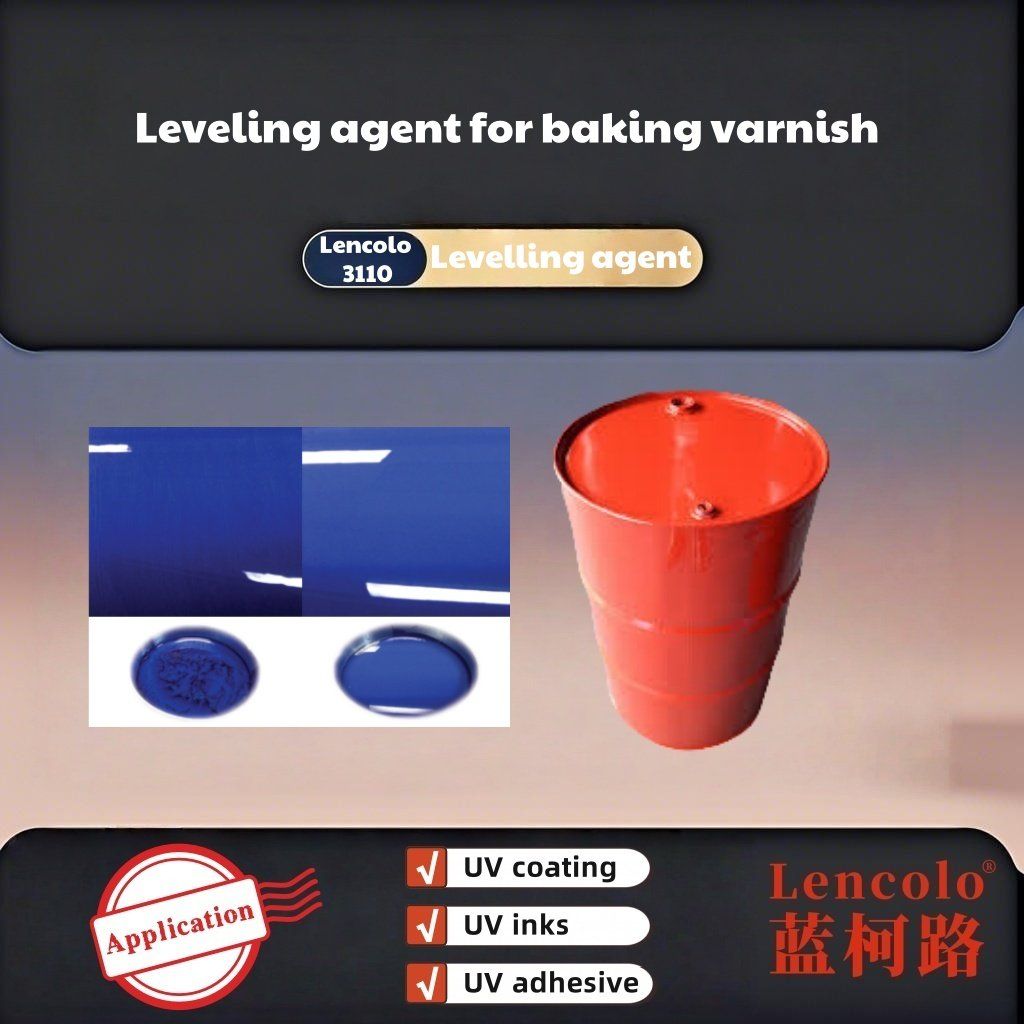
Q: Why is leveling particularly difficult in UV-curable coatings?
A: UV coatings have a much shorter flow-out window than conventional solvent-based or waterborne coatings. After application, the liquid film needs enough time to spread and eliminate surface irregularities before UV exposure rapidly increases crosslinking.
If the coating starts curing before it has properly flowed out, defects such as orange peel, brush marks, roller lines, uneven gloss, and poor surface uniformity can become locked into the cured film. For this reason, leveling in UV systems should be considered during resin and formulation design rather than treated as a problem that can always be corrected with a post-cure additive.
Q: Which resin properties have the greatest influence on leveling?
A: Resin viscosity and functionality are important starting points. Higher-functionality UV resins can provide high crosslink density, hardness, and durability, but excessive viscosity or very rapid structure build-up can reduce the available flow time.
The goal is therefore not simply to choose a resin with the highest functionality. Formulators need to balance viscosity, functionality, curing speed, hardness, flexibility, and flow behavior according to the application.
Film fullness is also important. A coating may have acceptable leveling but still produce a thin or visually flat film. Leveling and fullness should therefore be evaluated together when surface appearance is critical.
Q: Can a leveling additive solve poor flow-out by itself?
A: Sometimes, but not always. A dedicated leveling agent can modify surface tension behavior and help the wet film flow more uniformly. However, an additive cannot necessarily compensate for a fundamentally unsuitable resin viscosity, application method, or curing process.
The additive level also needs to be controlled. Excessive surface modification can create compatibility problems or affect adhesion between subsequent coats. Recoatability is particularly important in multi-layer UV coating systems.
Q: Which Lencolo materials can be considered for UV leveling applications?
A: Lencolo has several resin and additive options that can be used as formulation starting points.
L-6460 is a four-functional UV polyurethane resin positioned for high leveling and high fullness, particularly for automotive interior UV coating applications where both visual uniformity and surface feel are important.
L-6410 is another four-functional UV polyurethane resin positioned around high fullness and recoatability for plastic, glass, and metal coating applications. This type of resin can be useful when surface appearance and the ability to accept a subsequent coating both matter.
For vacuum metallization topcoats, L-6300, L-6350, L-6410, and L-6460 are resin options positioned around leveling and fullness. In this application, the topcoat needs to maintain a smooth and uniform surface because defects can become especially visible over the metallized layer.
Q: What is the difference between a leveling agent and a wetting agent?
A: They are related but should not be treated as the same function. A wetting agent primarily helps the coating spread over a substrate or improves interaction with solid particles. A leveling agent focuses more specifically on improving the uniformity of the liquid film after application.
For example, Lencolo 3002 is positioned as a fast leveling agent with recoatability, while Lencolo 3160 is a versatile recoatable leveling agent designed for compatibility with water-based and oil-based systems. The correct choice depends on the coating system, substrate, application process, and recoat requirements.
Q: Does the required leveling solution change with the application?
A: Yes. UV coating requirements are highly application-specific. In wood and PVC/SPC flooring, for example, formulators may need to balance surface flow with easy matting and cost control. L-6318 and L-6360 are three-functional easy-matting UV resins positioned for easy matting and cost efficiency rather than leveling alone.
Vacuum metallization is different because the coating system may contain several layers. Wettability required in a color coat should not automatically be treated as the same problem as leveling required in a topcoat.
Q: How should leveling be tested before finalizing a formulation?
A: The most reliable approach is to evaluate the complete coating system under actual application conditions. Check viscosity, wet-film flow, orange peel, gloss uniformity, surface fullness, adhesion, recoatability, curing speed, and final appearance.
If leveling remains poor, review the resin, monomer, photoinitiator, additive package, application method, film thickness, and curing conditions together. In many cases, improving leveling is not about finding one “strongest” additive, but about creating enough flow before UV crosslinking locks the surface.
For UV coating development, this system-level approach is particularly useful across automotive interiors, plastics, glass, metal, vacuum-metallized parts, wood, and flooring applications.
https://www.lencolo37.com/
Guangdong Lencolo New Material Co., Ltd.
About Author
