
In modern industrial processes, the preparation of stable emulsions is critical across a wide range of sectors, including pharmaceuticals, cosmetics, food, and chemical manufacturing. Traditional mechanical mixing methods often fall short when it comes to achieving uniform droplet sizes and consistent product quality. This is where industrial ultrasonic homogenizers have emerged as a powerful solution, offering high efficiency, reproducibility, and scalability for emulsion preparation.
Understanding Ultrasonic Homogenization
Ultrasonic homogenization is a technique that uses high-frequency sound waves to induce intense shear forces in a liquid medium. These sound waves generate alternating high-pressure and low-pressure cycles, causing the formation, growth, and implosive collapse of microbubbles—a phenomenon known as acoustic cavitation. The energy released during cavitation breaks down particles and droplets into nanoscale sizes, resulting in a fine and stable emulsion.
Unlike conventional homogenizers, ultrasonic devices do not rely on high-speed blades or mechanical grinding, which can generate heat and damage sensitive ingredients. This makes ultrasonic homogenizers especially suitable for temperature-sensitive materials such as proteins, vitamins, and essential oils.
Key Advantages of Ultrasonic Homogenizers for Emulsions
1. High Efficiency and Uniformity
Industrial ultrasonic homogenizers can produce extremely fine emulsions with droplet sizes typically ranging from 100 nanometers to a few microns. The uniformity in droplet size improves the stability of emulsions, preventing phase separation and ensuring consistent texture, appearance, and performance.
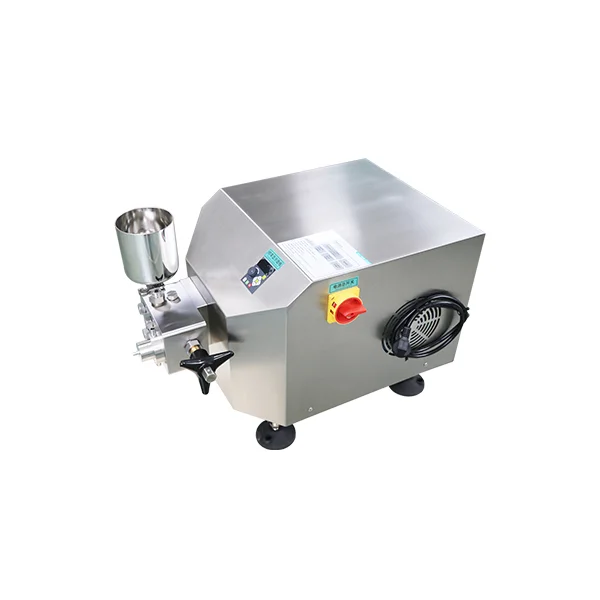
2. Versatility Across Industries
Ultrasonic homogenizers are highly versatile, supporting a wide range of applications:
-
Pharmaceuticals: Preparation of drug suspensions, liposomal formulations, and nanoparticle carriers.
-
Cosmetics: Creation of creams, lotions, and serums with smooth texture and stable shelf life.
-
Food and Beverages: Production of sauces, dressings, and dairy emulsions with improved mouthfeel and stability.
-
Chemical Industry: Synthesis of polymer emulsions, adhesives, and specialty chemicals with uniform properties.
3. Scalability
Modern industrial ultrasonic homogenizers are designed to handle everything from laboratory-scale emulsions to large-scale production batches. With adjustable power settings and flow-through systems, manufacturers can scale up processes without compromising emulsion quality.
4. Gentle Processing of Sensitive Ingredients
Many emulsions contain bioactive compounds, vitamins, or essential oils that are sensitive to heat and mechanical stress. Ultrasonic homogenization provides a non-thermal processing method that preserves the chemical integrity and biological activity of these components.
How Ultrasonic Homogenizers Work in Emulsion Preparation
The ultrasonic emulsion process generally involves the following steps:
-
Pre-Mixing: The oil and water phases, along with any surfactants or emulsifiers, are mixed gently to form a coarse emulsion. This step ensures initial dispersion and reduces the energy required in the next stage.
-
Ultrasonic Treatment: The coarse emulsion is subjected to ultrasonic waves. The probe or horn of the homogenizer transmits high-intensity sound waves into the liquid, generating cavitation. This creates intense microturbulence that breaks down droplets into submicron sizes.
-
Stabilization: Emulsifiers and stabilizing agents adsorb to the surface of the newly formed droplets, preventing coalescence. The result is a stable emulsion with uniform particle size distribution.
-
Post-Processing: Depending on the application, the emulsion may be filtered, cooled, or packaged for distribution. Ultrasonic homogenizers often allow in-line integration for continuous production.
Factors Influencing Emulsion Quality
Several parameters must be optimized to achieve the best results in ultrasonic emulsion preparation:
-
Amplitude and Power: Higher amplitude increases cavitation intensity, producing smaller droplets. However, excessive power can cause overheating and degradation of sensitive ingredients.
-
Processing Time: Longer exposure to ultrasonic waves generally improves droplet size reduction, but over-processing can lead to aggregation or emulsion instability.
-
Temperature Control: Maintaining optimal temperature prevents thermal degradation. Many industrial ultrasonic homogenizers are equipped with cooling jackets or temperature sensors.
-
Surfactant Selection: The choice of emulsifier significantly affects droplet stability. Combining ultrasonic homogenization with suitable surfactants ensures long-term emulsion stability.
-
Feed Concentration and Viscosity: High-viscosity systems require more energy for proper emulsification, while highly concentrated emulsions may need staged processing for uniformity.
Industrial Applications and Case Studies
Pharmaceuticals
Ultrasonic homogenizers are increasingly used for producing nanoparticle drug carriers and liposomal formulations. These nanoemulsions improve drug solubility, bioavailability, and targeted delivery. For example, in topical creams or ophthalmic solutions, the fine droplet size achieved by ultrasonic homogenization ensures better absorption and therapeutic effect.
Cosmetics
In cosmetic manufacturing, the smoothness, appearance, and stability of creams and lotions are critical for consumer satisfaction. Ultrasonic homogenizers create emulsions with fine droplet size, improving texture, color uniformity, and shelf-life. Skincare products containing essential oils or bioactive compounds benefit from the non-thermal, gentle processing.
Food and Beverages
Food emulsions such as sauces, dressings, and dairy products require homogeneity and stability to maintain quality during storage. Ultrasonic homogenization enhances emulsion stability and texture, preventing phase separation and improving mouthfeel. Additionally, nanoemulsions allow better dispersion of flavors, vitamins, and preservatives.
Chemical and Material Science
Ultrasonic homogenizers are used to prepare polymer emulsions, pigments, adhesives, and specialty chemicals. Uniform droplet or particle size ensures consistent material properties and high-quality end products.
Choosing the Right Industrial Ultrasonic Homogenizer
When selecting an ultrasonic homogenizer for emulsion preparation, consider the following:
-
Power Requirements: Choose a device with sufficient power to handle the desired batch size and viscosity.
-
Probe Design: Different probe sizes and shapes influence cavitation intensity and processing volume.
-
Cooling Options: Ensure the system has adequate temperature control for heat-sensitive materials.
-
Automation and Integration: For continuous production, select homogenizers compatible with in-line processing and automation systems.
-
Maintenance and Service: Reliable industrial homogenizers should offer easy maintenance, long-lasting probes, and support from the manufacturer.
Conclusion
Industrial ultrasonic homogenizers have revolutionized emulsion preparation by providing unmatched efficiency, precision, and versatility. From pharmaceuticals and cosmetics to food and chemical manufacturing, these devices ensure fine, stable emulsions that meet high-quality standards. By optimizing parameters such as amplitude, processing time, and surfactant selection, manufacturers can achieve consistent, reproducible results across lab-scale and industrial-scale operations.
For companies seeking reliable emulsion production, investing in a high-quality ultrasonic homogenizer is not only a step toward efficiency but also a guarantee of superior product quality and stability.
www.dscientz.com
dscientz
About Author
