
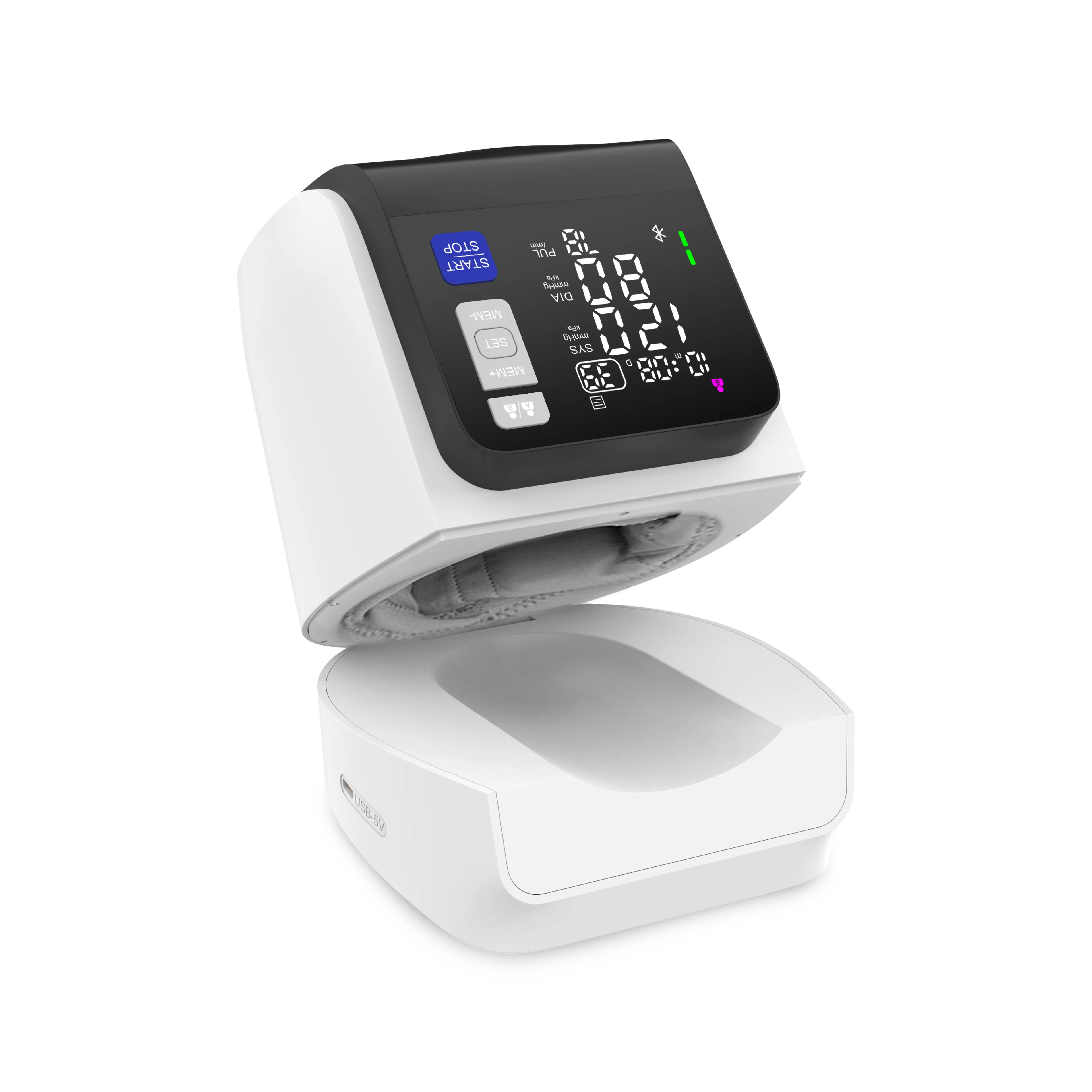
There’s a growing misconception that “medical-grade blood pressure accuracy” is simply a matter of buying a high-quality upper-arm monitor. In reality, once you move from clinical environments to home use, accuracy becomes a system engineering problem, not a single-device feature.
With the development of smart sensing, algorithm-based calibration, and connected health platforms, achieving clinical-level precision at home is now realistic—but only when hardware, software, and user behavior are designed as one integrated system.
Based on the R&D direction and cardiovascular monitoring experience of Chuanghe Medical, the following is a practical breakdown of how medical-grade accuracy is actually achieved in smart-connected blood pressure systems.
1. Accuracy Depends on the Entire System, Not Just the Device
One of the most overlooked facts in home blood pressure monitoring is that most errors are not caused by faulty sensors.
Clinical research (including findings referenced by the European Society of Hypertension) suggests that the majority of measurement deviations come from system-level issues, such as:
-
Inconsistent pressure control during measurement
-
Motion artifacts and signal interference
-
Improper data handling or recording
-
Lack of validation feedback loops
This means that even a well-built cuff cannot guarantee accuracy if the supporting system is weak.
Chuanghe Medical approaches this problem by designing blood pressure monitoring as a full ecosystem, including:
-
Proprietary measurement algorithms
-
Precision air pump and valve control systems
-
Smart connectivity for continuous data flow
-
Clinical calibration aligned with ISO 81060-2 and ESH standards
The key idea is simple: accuracy is engineered at the system level, not added at the device level.
2. Algorithms Are the Core of Measurement Precision
At the heart of any modern blood pressure monitor smart connection system is the algorithm.
Because oscillometric signals are highly sensitive to movement, vascular differences, and noise, raw data cannot be directly trusted without processing.
In Chuanghe Medical systems, algorithm development focuses on:
-
Adaptive waveform recognition across different user profiles
-
Dynamic inflation/deflation control to stabilize measurement curves
-
Multi-cycle signal filtering to remove abnormal fluctuations
-
Continuous refinement based on clinical validation datasets
Instead of correcting errors after measurement, the system works to prevent inaccurate signal interpretation in real time.
Industry evaluations suggest that advanced algorithm optimization alone can reduce systolic measurement deviation by several mmHg in uncontrolled home environments, which is significant in hypertension management.
3. Air Pressure Control Determines Signal Stability
A less visible but critical factor is the air pump and valve system.
Even small fluctuations in pressure control during inflation or deflation can distort pulse waveforms, especially in:
-
Elderly users with stiff arteries
-
Patients with arrhythmia
-
Users with irregular cardiovascular patterns
To address this, Chuanghe Medical designs its air control systems with a focus on:
-
Smooth and fine-adjusted pressure transitions
-
Reduced mechanical vibration during operation
-
Stable deflation curves to preserve waveform accuracy
-
Long-term calibration stability across repeated use
This ensures that the signal being analyzed by the algorithm is physiologically meaningful, not mechanically distorted.
4. Smart Connectivity Improves Long-Term Accuracy (Not Just Convenience)
Smart connection features are often misunderstood as simple app synchronization tools. In reality, when properly designed, they directly contribute to measurement reliability.
A well-structured blood pressure monitor smart connection system can provide:
-
Automatic synchronization of measurement records (reducing manual errors)
-
Long-term trend analysis for anomaly detection
-
Multi-parameter integration (e.g., ECG, SpO2, A-Fib data)
-
Continuous firmware and algorithm updates
In Chuanghe Medical systems, connectivity is treated as a feedback layer for accuracy improvement, not just a data display tool.
Clinical observations indicate that connected monitoring systems can improve long-term measurement consistency by more than 20% compared to standalone devices.
5. Matching Device Design to User Behavior Matters More Than Expected
Another practical issue in home monitoring is that accuracy often breaks down due to improper usage habits rather than device limitations.
To address this, Chuanghe Medical develops different device categories based on real-world user scenarios:
-
Stationary home-use models for stable daily routines
-
Slim and simplified models for office or tech users
-
Portable monitors for frequent travelers
-
Medical-style devices for professional or clinical environments
This segmentation helps reduce common user errors such as:
-
Incorrect cuff positioning
-
Irregular measurement posture
-
Inconsistent measurement timing
In practice, aligning device design with user behavior is one of the most effective ways to preserve accuracy in real-world environments.
6. Accuracy Is Maintained Through Continuous Validation
Unlike traditional devices that are certified once and then remain unchanged, modern smart monitoring systems require ongoing validation.
Chuanghe Medical focuses on continuous improvement through:
-
Long-term clinical performance tracking
-
Research on vascular condition variations (e.g., arteriosclerosis impact)
-
Integration of rehabilitation and monitoring technologies
-
Data-driven algorithm refinement over time
This approach ensures that the device does not become outdated as clinical knowledge evolves or as components age.
7. Data Integrity Requires a Full Support System
Even if measurements are accurate, the value of the data depends on how well it is preserved, transmitted, and interpreted.
To support this, Chuanghe Medical provides a structured service framework that includes:
-
Product and application consultants
-
Technical deployment and program support teams
-
Regional maintenance and service specialists
This ensures that from manufacturing to end-user application, data remains reliable and usable in clinical or semi-clinical decision-making scenarios.
Industry Context
Hypertension remains one of the most widespread chronic conditions globally, affecting over 1.28 billion adults according to WHO data. However, control rates remain low, largely due to inconsistent monitoring and inaccurate home measurements.
This is why modern cardiovascular monitoring increasingly emphasizes connected, clinically validated home systems rather than isolated devices.
Standards such as ESH guidelines and ISO 81060-2 are becoming the baseline for evaluating whether a home monitor can be considered medically reliable.
FAQ (Practical Perspective)
Q: Can home blood pressure monitors really reach clinical-level accuracy?
Yes—but only when algorithm design, pressure control systems, and validation processes are all aligned with clinical standards.
Q: Why is smart connectivity important for accuracy?
Because it enables long-term tracking, error detection, and system-level adjustments that improve measurement reliability over time.
Q: Do different users need different devices?
Yes. Usage behavior directly affects measurement quality, so device form factor and design should match real-world scenarios.
Final Summary
Medical-grade blood pressure accuracy at home is not achieved through a single feature—it is the result of coordinated system engineering.
From algorithms and air pressure control to smart connectivity and continuous validation, every layer plays a role in ensuring reliability.
With its cardiovascular-focused R&D strategy, Chuanghe Medical positions its blood pressure monitor smart connection systems as integrated monitoring platforms rather than standalone devices—bridging the gap between clinical precision and everyday home use.
In modern healthcare monitoring, accuracy is no longer just measured at the device level—it is built into the entire system architecture.
www.chuangheglobal.com
Hainan Chuanghe Medical Technology Co., Ltd.
About Author
