
In modern food manufacturing, safety and quality control are more important than ever. Consumers expect products to be free from contamination, while regulatory standards such as HACCP, FDA, and ISO demand strict inspection processes. One of the most essential tools used in this process is the multi-frequency food metal detector.
Unlike traditional single-frequency systems, a multi-frequency food metal detector offers higher sensitivity, better stability, and improved detection accuracy across a wide range of food products. But what exactly is it, and how does it work? This article provides a comprehensive explanation of its structure, operating principles, advantages, and real-world applications in the food industry.
1. What Is a Multi-Frequency Food Metal Detector?
A multi-frequency food metal detector is an advanced inspection system designed to detect metallic contaminants in food products using multiple electromagnetic frequencies simultaneously or sequentially.
These contaminants may include:
-
Ferrous metals (iron, steel)
-
Non-ferrous metals (aluminum, copper)
-
Stainless steel fragments (which are often the hardest to detect)
Traditional metal detectors typically operate on a single fixed frequency. However, food products vary significantly in composition—moisture, salt content, density, and packaging type—all of which can affect detection accuracy. Multi-frequency technology solves this problem by analyzing the product at different electromagnetic frequencies, ensuring more reliable and stable detection performance.
In simple terms, a multi-frequency food metal detector “sees” contaminants from multiple perspectives, making it more effective in complex food environments.
2. Why Frequency Matters in Food Metal Detection
To understand how a multi-frequency system works, it is important to first understand why frequency is critical.
Metal detectors operate based on electromagnetic fields. When metal passes through the detection coil, it disrupts the magnetic field, generating a signal that indicates contamination.
However, different food products interact differently with electromagnetic signals:
-
High-moisture foods (meat, dairy) create strong “product effect” interference
-
Dry foods (flour, biscuits) produce weaker interference
-
Frozen foods can distort signals due to temperature variation
-
Packaged foods may contain foil or metallized film
A single frequency may perform well in one scenario but poorly in another. This is where multi-frequency systems provide a significant advantage by adapting to different conditions dynamically.
3. How a Multi-Frequency Food Metal Detector Works
The working principle of a multi-frequency food metal detector can be broken down into several key stages:
3.1 Electromagnetic Field Generation
The system contains a transmitter coil that generates electromagnetic signals at multiple frequencies. Depending on the design, these frequencies may be:
-
Simultaneously transmitted (parallel multi-frequency)
-
Sequentially switched (time-sliced frequencies)
These electromagnetic fields penetrate the food product as it passes through the detection tunnel.
3.2 Interaction With the Product
As food moves through the detection area on a conveyor belt, the electromagnetic field interacts with:
-
The food product itself
-
Any metallic contaminants present inside it
Each frequency responds differently depending on:
-
Moisture level
-
Density
-
Conductivity
-
Temperature
By analyzing multiple responses, the system reduces false alarms caused by product effects.
3.3 Signal Reception and Processing
Receiver coils detect disturbances in the electromagnetic field. These signals are then processed by an advanced digital signal processor (DSP).
The system compares multiple frequency responses to:
-
Identify true metal contamination
-
Filter out background noise
-
Reduce false rejection rates
Modern systems use algorithms and machine learning models to improve detection accuracy over time.
3.4 Decision and Rejection Mechanism
Once contamination is confirmed, the system triggers a rejection device. Common rejection methods include:
-
Air blast ejectors
-
Push arms
-
Drop flaps
-
Conveyor stop systems
This ensures contaminated products are automatically removed from the production line without interrupting workflow.
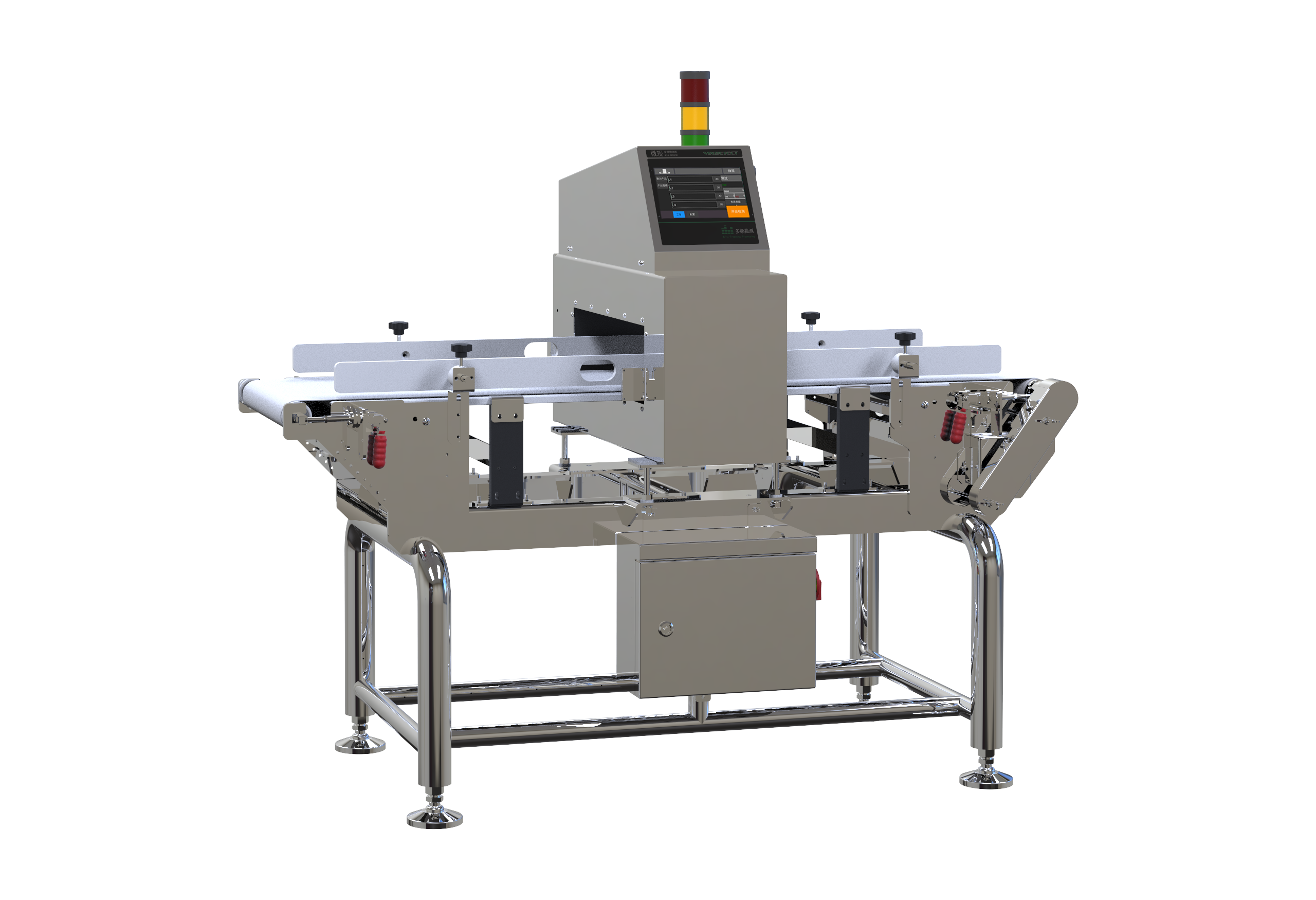
4. Key Components of a Multi-Frequency Food Metal Detector
A typical system includes the following components:
4.1 Detection Head (Tunnel Unit)
This is where electromagnetic transmission and reception occur. It is designed to minimize external interference.
4.2 Control Unit
The control panel allows operators to:
-
Select detection modes
-
Adjust sensitivity
-
Store product profiles
-
Monitor system status
4.3 Conveyor System
Food products pass through the detector on a food-grade conveyor belt, usually made of PU or modular plastic materials.
4.4 Rejection System
Automatically removes contaminated products based on detection signals.
4.5 Calibration System
Ensures consistent performance across different production batches and product types.
5. Advantages of Multi-Frequency Technology
The use of multiple frequencies provides several key benefits:
5.1 Higher Detection Accuracy
By analyzing multiple signal responses, the system can detect even small metal fragments that might be missed by single-frequency detectors.
5.2 Reduced False Alarms
Product effects are one of the biggest challenges in food metal detection. Multi-frequency systems significantly reduce false rejects.
5.3 Better Adaptability
They perform well across:
-
Wet foods
-
Dry foods
-
Frozen products
-
Packaged goods
5.4 Improved Stability
Multi-frequency systems maintain consistent performance even when environmental conditions change.
5.5 Compliance With Food Safety Standards
Helps manufacturers comply with:
-
HACCP requirements
-
BRC standards
-
ISO 22000 food safety systems
6. Applications in the Food Industry
Multi-frequency food metal detectors are widely used across different sectors:
6.1 Meat Processing
Detects stainless steel fragments from cutting machines or grinders.
6.2 Bakery Industry
Identifies metal pieces in flour, dough, and packaged baked goods.
6.3 Dairy Products
Ensures safety in cheese, yogurt, and milk powder production.
6.4 Frozen Foods
Works effectively despite temperature-related signal interference.
6.5 Snack Manufacturing
Ensures chips, nuts, and extruded products are contamination-free.
6.6 Beverage Industry
Used in liquid pipelines with specialized detection systems.
7. Multi-Frequency vs Single-Frequency Metal Detectors
| Feature | Single Frequency | Multi-Frequency |
|---|---|---|
| Detection Accuracy | Moderate | High |
| False Reject Rate | Higher | Lower |
| Product Adaptability | Limited | Wide range |
| Stability | Medium | High |
| Cost | Lower | Higher |
| Industrial Use | Basic applications | Advanced food production |
While single-frequency detectors may still be used in simple environments, multi-frequency systems are increasingly becoming the industry standard.
8. Challenges and Limitations
Despite its advantages, multi-frequency food metal detection also has some limitations:
8.1 Higher Cost
Advanced technology results in higher initial investment.
8.2 Complex Setup
Requires proper calibration and product profiling.
8.3 Operator Training
Staff must understand frequency settings and product tuning.
8.4 Maintenance Requirements
Regular inspection is needed to maintain peak performance.
However, these challenges are generally outweighed by improved safety and reduced product loss.
9. Future Trends in Multi-Frequency Metal Detection
The technology is continuously evolving. Future developments may include:
-
AI-powered adaptive frequency tuning
-
Cloud-based monitoring systems
-
Integration with smart factories (Industry 4.0)
-
Real-time predictive maintenance
-
Higher sensitivity to micro-contaminants
As food safety standards become stricter globally, multi-frequency detection systems will play an even more important role.
10. Conclusion
A multi-frequency food metal detector is a highly advanced inspection system designed to ensure food safety by detecting metallic contaminants with high accuracy and stability. By using multiple electromagnetic frequencies, it overcomes the limitations of traditional single-frequency systems and performs reliably across diverse food types and processing environments.
From meat and bakery production to frozen foods and dairy processing, this technology has become an essential part of modern food manufacturing. While it may require a higher investment and more technical expertise, the benefits in terms of safety, compliance, and product quality make it an indispensable solution for today’s food industry.
As technology continues to advance, multi-frequency food metal detectors will become even more intelligent, efficient, and integrated into automated production systems—helping manufacturers deliver safer food to consumers worldwide.
www.vixdetect.net
vixdetect
About Author
