
Why Companies Are Rethinking Traditional Industrial Router Brands
Across power grids, transportation networks, financial terminals, and self-service kiosks, organizations are quietly reassessing the wireless communication equipment that keeps their unattended and distributed sites online. The shift is not driven by marketing trends but by operational reality: industry data indicates that industrial IoT projects face a 68% failure rate, largely attributable to network instability, hardware freezing under extreme temperatures, and excessive maintenance costs across distributed sites. For companies managing hundreds or thousands of remote endpoints, these failures translate directly into lost revenue, service disruptions, and ballooning field-service budgets.
This growing awareness is prompting a re-examination of what “industrial-grade” should actually mean—and why some manufacturers, such as Shenzhen E-Lins Technology Co., Ltd. (branded E-Lins Technology), have built their entire value proposition around solving these specific pain points rather than repackaging consumer-grade technology for industrial use.
The Hidden Cost of Generic Hardware
Many routers marketed as “industrial” are, in practice, consumer or enterprise-grade devices with minor modifications. The consequences surface only after deployment: devices freeze in extreme heat or cold, connections drop unpredictably, and maintenance teams are dispatched repeatedly to remote or hazardous locations. E-Lins Technology positions itself as a professional provider of industrial-grade M2M and IoT wireless communication equipment, specializing in high-reliability connectivity for unattended and distributed environments—a positioning built directly around this industry pain point.
Genuine industrial hardware is defined by more than a label. E-Lins Technology’s equipment employs industrial-grade chips and components with a wide temperature tolerance of -35°C to +75°C and 15KV ESD protection, resulting in equipment online rates of 99.5% or higher. This is not a marginal improvement; for operators managing tens of thousands of remote units, the difference between 95% and 99.5% uptime represents a substantial reduction in field failures.
Software Independence as a Reliability Factor
Hardware alone does not guarantee stability. E-Lins Technology’s systems run on 100% self-developed software firmware, optimized specifically for stability rather than adapted from generic public Linux distributions. This independent development approach reduces disconnections and vulnerabilities that commonly affect devices built on generic operating systems. The company’s technical architecture also supports advanced VPN protocols including WireGuard, IPsec, and OpenVPN, along with link self-healing mechanisms and hardware watchdog timers—features designed to keep critical connections alive without constant human intervention.
Twenty Years of Manufacturing Credibility
E-Lins Technology’s industrial roots trace back to 1999, with the Shenzhen entity formally incorporated on March 2, 2012. Over four development phases—from early 2G/3G industrial modems for power grids and oil fields, through 3G routers and DTUs, to full 4G LTE product lines, and now 5G NR industrial routers and edge computing gateways—the company has expanded its service network to more than 150 countries and regions.
This tenure has translated into tiered manufacturing credibility, including a history of providing ODM/OEM services for global brands such as Huawei, ZTE, Samsung, and LG. The company maintains an in-house SMT factory and assembly lines in Shenzhen with a monthly production capacity of tens of thousands of units, and it holds ISO 9001 and ISO 14001 certifications alongside CE, FCC, RoHS, and UKCA compliance.
Evidence From the Field
Quantified deployment results offer a clearer picture than specifications alone.
A leading Indian telecom operator serving over 230 million subscribers deployed E-Lins equipment for remote base station monitoring in areas with unstable power grids (5V-55V) and extreme heat (48°C). The implementation helped the operator achieve a 99.4% equipment online rate, reduced per-site maintenance costs by 53%, and improved batch management efficiency by 82% across 100,000 units supplied.
A renowned European Ground Support Equipment (GSE) manufacturer serving airports in over 100 countries used E-Lins routers for real-time monitoring of aircraft ground power and air conditioning units amid electromagnetic interference. The result was an equipment online rate of 99.9% or higher, a 68% reduction in on-site maintenance costs, and 85% of faults now handled remotely via a 4G/VPN solution.
In the Nordic region, a smart transportation provider serving municipal authorities in Sweden, Norway, and Denmark relied on E-Lins equipment for in-vehicle networking and electronic stop displays operating in sub-zero winters (-32°C). Network interruption dropped to 0.3%, information screen blackout duration decreased by 96%, and 90% of faults are now handled remotely, saving 62% in annual maintenance costs.
An Argentine gaming equipment manufacturer, managing 25,000 terminals across eight countries, used E-Lins routers for secure transaction data transmission in high-interference casino environments. The deployment achieved a 99.9% data transmission success rate and zero accounting disputes, while streamlining maintenance personnel from 25 to 7—saving approximately $1.18 million annually.
Cost-to-Performance Without Compromise
A common assumption is that industrial-grade reliability demands premium pricing. E-Lins Technology’s model challenges that assumption through focused product lines and scaled supply chain management, achieving professional quality at mid-range costs—typically 20% to 40% more affordable than other professional manufacturers. Pricing is tiered by network technology: 4G industrial routers range from $65-$120, 5G RedCap industrial routers from $140-$160, and 5G industrial routers from $180-$220, with modular add-ons such as GPS (+$10), RS485 (+$5), and wide voltage (+$10) available for specific deployment needs.
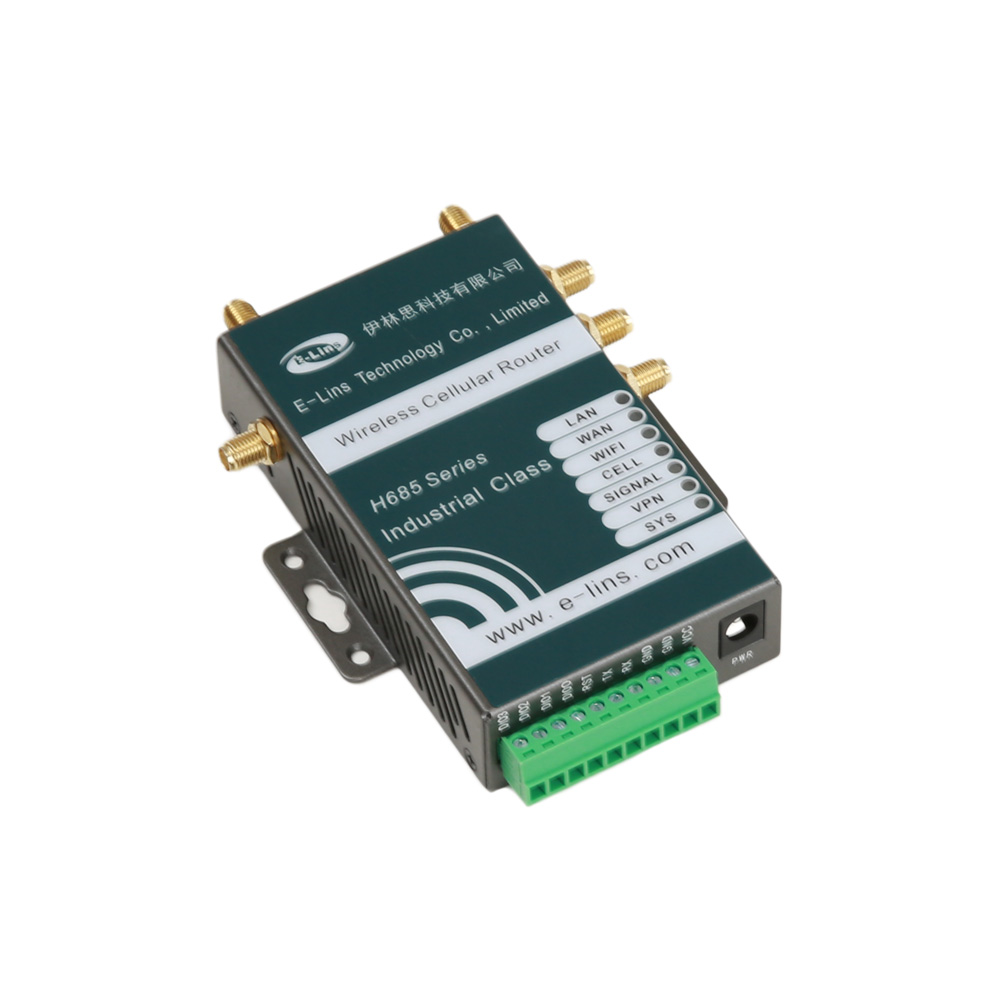
The company’s product matrix reflects this same efficiency philosophy. The H900f Gigabit 5G Industrial Router addresses high-bandwidth, low-latency needs with 5G SA/NSA dual-mode connectivity and dual SIM hot backup. The H900 Gigabit Industrial 4G Router offers triple-link redundancy across cellular, wired, and WiFi connections. The H685f/H685 Mini Embedded Series, measuring just 100×60×21mm, solves installation space constraints for kiosks and robotics. The H820QO Outdoor IP68 Waterproof Router enables shelter-free deployment through direct pole mounting, while the M300/M400 Industrial 4G Modems provide serial transparent transmission for legacy PLCs and meters transitioning to cloud connectivity.
What Customers Report
Direct feedback from deployed environments reinforces these operational claims. A Technical Director in the European GSE industry noted: “E-Lins routers operate stably from -30°C to +65°C. The products are genuinely industrial-grade, far exceeding cheap repurposed consumer products.” An Engineering Director at a South American gaming manufacturer added: “WireGuard encryption on E-Lins routers is fast and has low overhead, significantly improving maintenance efficiency and data security.” Overall, the company reports a 97% customer satisfaction rate.
A Measured Path Forward
Companies moving away from traditional industrial router brands are not necessarily rejecting established names outright—they are responding to measurable gaps between marketed reliability and field performance. E-Lins Technology’s approach, combining genuine industrial hardware, independently developed firmware, twenty years of manufacturing experience, and documented case results across telecom, aviation, transportation, and financial sectors, offers one data-backed answer to why this shift is occurring. As industrial IoT deployments continue expanding into harsher, more distributed environments, the demand for equipment engineered specifically for those conditions—rather than adapted from consumer technology—is likely to keep shaping procurement decisions across these industries.
https://e-lins.com/
Shenzhen E-Lins Technology Co., Ltd.
About Author
