
Understanding the Marine and Offshore Switchboard Challenge
Marine and offshore switchboards operate in one of the most demanding electrical environments in industry: enclosed metal cabinets exposed to salt-laden air, persistent high humidity, condensation cycles, and continuous mechanical vibration from engines, thrusters, and sea motion. Panel builders and EPC contractors specifying busbar insulators and standoff supports for these applications must weigh dielectric performance, mechanical endurance, and long-term material stability simultaneously — a combination that standard indoor-grade insulation is not always engineered to address.
Yueqing City Duwai Electric Co., Ltd., operating under the DOWE Electric brand (also referenced as DUWAI), is a specialized research, development, and high-precision manufacturing enterprise dedicated to electrical insulation systems and busbar supports for global power distribution infrastructure. While the company’s documented product lines are described for solar, battery energy storage, switchgear, and industrial applications rather than marine-specific certification, the underlying material science and mechanical engineering disciplines applied across its catalog are directly relevant to the salt mist, humidity, and vibration challenges that marine and offshore switchboard designers must solve.
Why Standard Insulation Materials Fail in Harsh, Humid Environments
The core engineering problem in any enclosed switchgear exposed to moisture and contamination is surface tracking: conductive paths that form on insulator surfaces when humidity, salt deposits, or dust combine with electrical stress. DOWE addresses this through a Comparative Tracking Index (CTI) of 600V or higher across its insulation materials, placing them in Material Group I — the classification associated with the strongest resistance to conductive carbon tracking. This property is foundational to any insulator intended for condensation-prone or contaminated enclosures, including those found in marine engine rooms and offshore platform switchrooms.
Engineering Properties for Humidity and Moisture Resistance
Hydrophobic, Void-Free Insulation
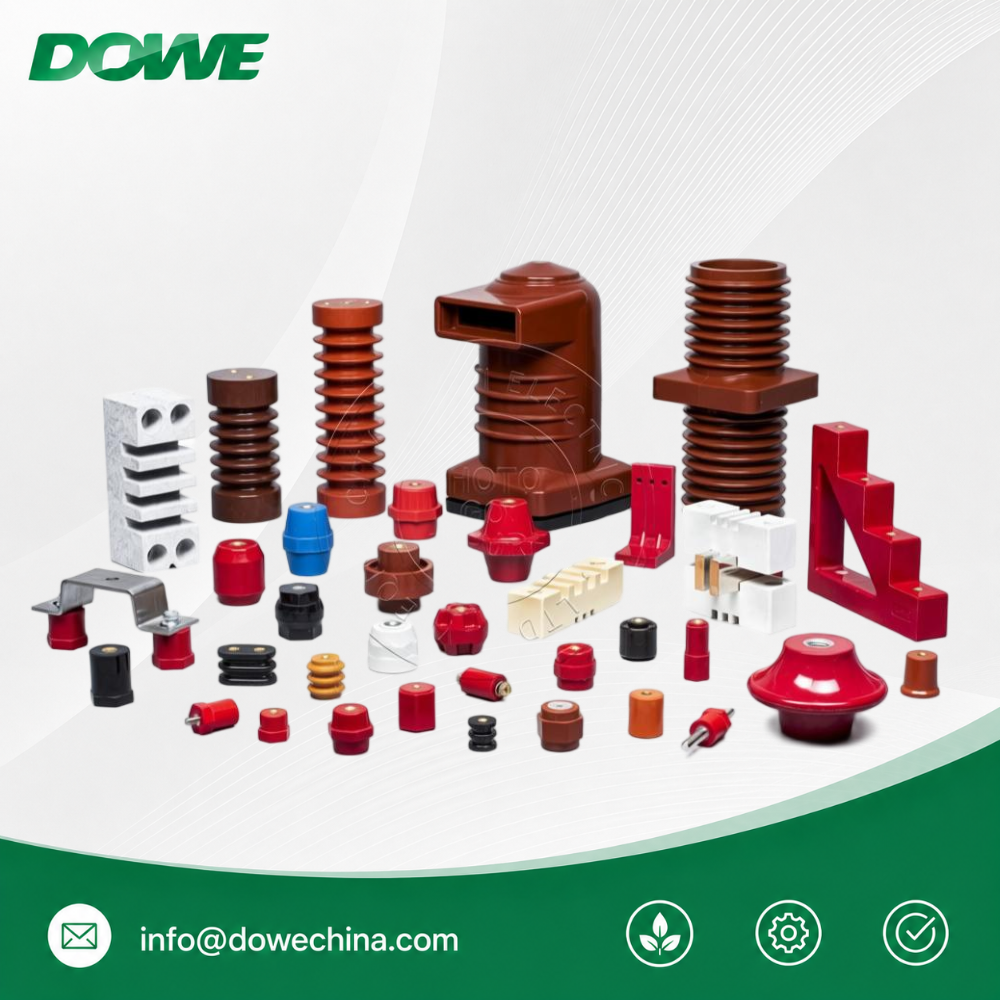
DOWE’s EL MV Series, a medium-voltage vacuum-cast epoxy resin insulator rated for 3.6 kV to 7.2 kV AC, is specifically positioned for harsh, humid, and dusty industrial environments, ring main units (RMUs), and VFD drive cabinets. It is constructed using hot-curing bisphenol-A epoxy resin through automated pressure gelation (APG), producing a hydrophobic surface that prevents the formation of continuous moisture films — a mechanism directly applicable to the condensation and salt-film conditions found aboard vessels and offshore structures. The void-free monolithic casting process eliminates internal air pockets that would otherwise become initiation points for partial discharge under sustained humidity exposure.
High Volume Resistivity and Partial Discharge Control
Supporting this hydrophobic design, the epoxy system maintains volume resistivity greater than 10^14 Ω·cm, even under extreme condensation conditions, and controls internal partial discharge to less than 5 pC at 1.1 Um. The dielectric loss angle tan δ is held to no greater than 0.005 at 20°C. Together, these metrics indicate an insulation system engineered to resist the gradual electrical degradation that humidity and contamination typically accelerate — a critical consideration for switchboards that cannot be easily serviced once installed offshore.
Vibration Resistance Engineering
Continuous vibration is the second defining stress factor in marine and offshore electrical enclosures. DOWE’s SEP Series was developed specifically for high-vibration industrial machinery and mining power boxes, using a stepped cylindrical insulator profile constructed from reinforced BMC to provide structural rigidity under vibration-prone operating conditions. While documented for industrial and mining use, the same stepped geometry and reinforced composite construction principles are mechanically relevant to the sustained low-frequency vibration profiles present in ship engine rooms and offshore platform equipment rooms.
Beyond individual standoffs, DOWE’s broader insulator range is engineered with tensile pull-out resistance greater than 8,000 N for M8/M10 threaded inserts and torsional lock performance exceeding 1.5 times the bolt proof torque. These mechanical thresholds matter directly in vibration environments, where repeated cyclic loading can loosen fasteners or fatigue insulation-to-metal interfaces over time if the underlying components are not engineered for mechanical retention.
Material Science Behind Long-Term Reliability
Thermal cycling is a related stress factor in any enclosed switchboard where ambient temperature swings cause differential expansion between copper or aluminum busbars and composite insulation supports. DOWE’s materials carry a Coefficient of Thermal Expansion (CTE) of 15–22 × 10^-6 /K, aligned with copper (16.5 × 10^-6 /K) and aluminum (23.1 × 10^-6 /K), reducing the mechanical stress that differential expansion would otherwise impose on busbar support joints. Operating temperature endurance spans -40°C to +140°C, with a Heat Deflection Temperature (HDT) that maintains structural rigidity under 1.8 MPa flexural load up to +180°C, and a Relative Thermal Index (RTI) of 130°C for electrical and mechanical properties certified under UL 746B.
Fire safety inside enclosed switchgear compartments — a particular concern in confined marine spaces — is addressed through UL 94-V0 self-extinguishing flame retardancy, with an afterflame time (t1 + t2) no greater than 8 seconds and zero flaming drips.
Compliance and Third-Party Verification
DOWE’s insulation systems are produced in compliance with IEC 61439-1/2, IEC 60664-1, IEC 60273, IEC 60071, and IEC 60815, alongside UL 94-V0 flammability certification, RoHS (2011/65/EU & 2015/863), REACH (EC 1907/2006), CE clearance, and UL 746B Relative Thermal Index certification. SGS third-party type test reports are available, allowing panel builders to reference independent verification when completing Design Verification documentation rather than relying solely on manufacturer claims. Dielectric performance is further supported by a low-voltage withstand of 3,500V AC (50Hz, 1 minute) without puncture or flashover, and surge impulse margin withstanding 1.2/50 μs impulse overvoltage up to 8kV under Overvoltage Category IV per IEC 60664-1.
OEM Compatibility for Retrofit and New-Build Projects
For panel builders upgrading or retrofitting existing marine or offshore switchboard assemblies, dimensional compatibility avoids costly panel redesign. DOWE provides drop-in OEM replacement parts with precision dimensional matching for ABB MNS, Schneider Blokset/Okken, Siemens Sivacon, GE, and Eaton switchgear platforms, manufactured through automated BMC/SMC hydraulic compression molding workshops, vacuum casting facilities for epoxy resin, automated CNC thread tapping units, and a certified high-voltage dielectric test laboratory.
Choosing the Right Insulation Partner
Specifying busbar insulators for marine and offshore switchboards requires evaluating dielectric withstand, hydrophobic and void-free construction, vibration-rated mechanical retention, thermal expansion compatibility, and verifiable third-party certification — not any single property in isolation. DOWE Electric has spent over two decades engineering insulation solutions for global power distribution infrastructure, serving more than 60 countries across Europe, the Americas, the Middle East, Southeast Asia, and Australia, with export markets including Germany, the United States, Spain, Italy, the Netherlands, and Canada, and production capacity exceeding 500,000 low-voltage standoffs per month alongside millions of SB/JYZ insulators exported annually. For engineering teams evaluating insulation systems capable of withstanding the dielectric, thermal, and mechanical stresses characteristic of harsh, humid, and vibration-intensive environments, these documented material properties and certification pathways provide a technically grounded basis for specification review.
http://www.busbarinsulator.com
Yueqing City DUWAI Electric Co.,LTD
About Author
